
 Vitalii Holben
Archive Job Postings for EEOC Salary Compliance
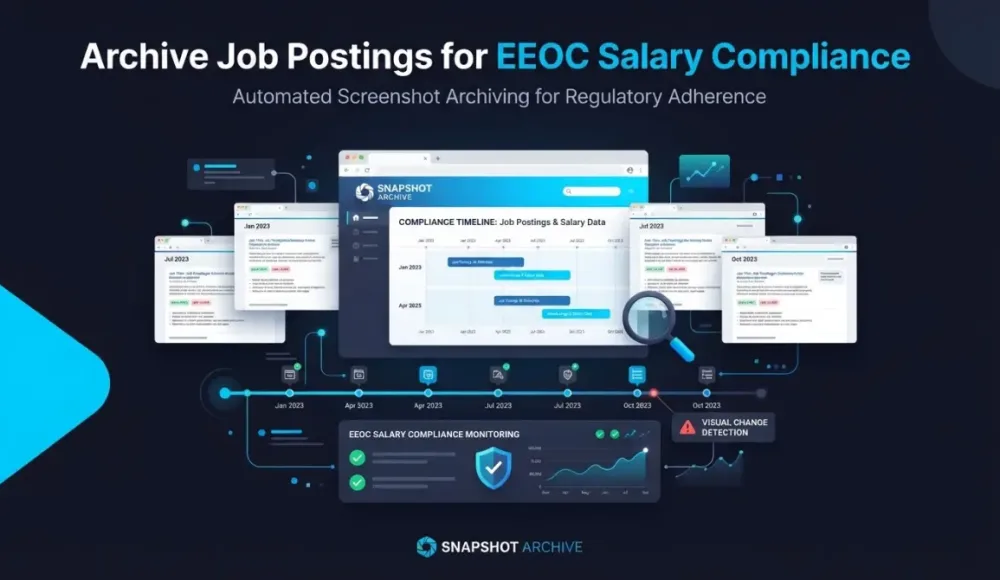
Right now in the US, a growing number of states require employers to include salary ranges in job postings. New York, California, Colorado, Washington, Illinois. The list keeps getting longer. But something like a quarter of job postings still don't include pay info, even where the law says they have to. That's not great.
And companies are getting fined for it. NYC alone has gone after big names like Tesla, News Corp, even ZipRecruiter (which is a job platform itself, so that's awkward). There have been over a thousand complaints filed in New York since the law kicked in, and the city has collected hundreds of thousands in penalties. Real companies, real money.
Here's where it gets tricky for HR and compliance teams: proving what a job posting actually said on a specific date is surprisingly hard. Job boards update listings constantly. Postings expire after 30 or 60 days. ATS platforms show different versions depending on location, device, or login status. By the time someone files a complaint, the original posting is gone.
Compliance evidence works backwards. You don't know you need proof until someone asks for it, and by then it's too late to go collect it.
What EEOC job posting retention actually requires
Federal EEOC guidelines say employers should keep job postings and related hiring records for at least one year from the date the position was filled (or from the posting date, if nobody was hired). Federal contractors get pushed to two years under OFCCP rules. And some state laws layer their own requirements on top.
But the format question is where most companies stumble. Keeping the text of a posting in your ATS doesn't capture what candidates actually saw. Job boards add their own formatting, salary display widgets, "apply now" buttons, and disclaimers. A plain-text export from your ATS and the live Indeed listing are two different things. If a candidate says "the posting didn't show a salary range," your internal copy might not settle it.
Most HR teams don't think about this until there's a complaint. Fair enough. Nobody wants to build an archiving workflow for something that might never happen. But when it does happen, the companies that can pull up a timestamped record of what the posting looked like are in a much stronger position than those digging through email threads.
Why job posting retention requirements are harder than they sound
Say you post the same role on Indeed, LinkedIn, Glassdoor, and your careers page. Each platform renders the listing differently. Indeed might show salary data in a sidebar widget. LinkedIn might pull it from structured data and display it in a banner. Your own careers page might bury it in a paragraph.
Now multiply that by every open role. And remember that these platforms update their layouts all the time without telling you. A posting that showed salary information in March might look different in April because the platform redesigned its job cards.
Salary transparency compliance gets messy when the evidence you need is scattered across platforms you don't control, in formats that change without notice, on pages that disappear after a few weeks.
What an ATS export misses
Your applicant tracking system stores what you entered. But it doesn't store what candidates saw. Cookie banners, location-based salary adjustments, platform-specific disclaimers, mobile layouts. If a complaint is about what the public-facing posting looked like, your ATS data might not answer it.
Archiving screenshots as pay transparency job posting records
One approach that holds up: take automated screenshots of your live job postings on a regular schedule and store them with timestamps. You get a visual record of exactly what candidates saw, on which date, on which platform.
This is what compliance archiving looks like in practice. Visual proof of the published page, not keyword monitoring or text scraping.
Screenshots work as evidence because they capture everything a candidate would see, including the parts your internal systems don't track. And if you're storing them with cryptographic hashes and timestamps, you can prove the screenshot hasn't been altered after the fact. That matters if things end up in front of a regulator. (We've written more about screenshots as legal evidence if you want the details.)
How Snapshot Archive handles EEOC job posting retention
Snapshot Archive is a scheduled screenshot tool. You give it URLs, set a capture frequency, and it takes full-page screenshots on autopilot. Every capture gets a timestamp watermark and a SHA-256 hash (a cryptographic fingerprint that proves the image hasn't been modified).
For job posting archiving, the setup is simple: add the URLs of your live postings on Indeed, LinkedIn, your careers page, wherever they're published. Set captures to daily or weekly. Snapshot Archive saves each version with a verifiable timestamp. If a posting changes or gets taken down, you still have the screenshot from before.
You can export any capture as a PDF with metadata for legal teams or regulators. And visual diff lets you compare captures side by side to spot when salary information was added, removed, or changed.
Starter plan runs $19 a month for up to 20 URLs with 180 days of retention. For a mid-size company with around 15 active postings across a couple of platforms, that covers it.
Worth being honest about what SA doesn't do: it doesn't parse the text of job postings, doesn't check whether your salary range meets state-specific requirements, and doesn't integrate with your ATS. It takes screenshots. That's the scope. If you need automated compliance checking against specific state laws, you'll need a different tool for that. SA gives you the visual evidence layer.
Making this practical
EEOC job posting retention doesn't have to be complicated. If this problem has been nagging at you, start small. Pick the three platforms where most of your postings live. Set up daily captures. You'll have a visual archive of every version of every posting, timestamped and hashed, without anyone on your team remembering to do it manually.
The companies that got fined in New York probably weren't trying to hide salary info. Most of them just didn't have a system for tracking what their postings actually showed on each platform. Knowing what you published and being able to prove it are different things. And the gap between those two is where fines happen.
You can look at what screenshot retention periods make sense for your situation, or check terms and privacy tracking if you're also dealing with policy page compliance. Both are part of the same problem: websites change, and you need proof of what they said.
Free tier lets you try it with 3 URLs. Pricing page has the full breakdown.
Start archiving websites today
Free plan includes 3 websites with daily captures. No credit card required.
Create free account
False Positives in Screenshot Monitoring: What Causes Them and What to Do
We got 14 alerts in one day from a single website. The problem was a live counter and a logo carousel triggering visual diff on every capture. Here is how we fixed it with threshold tuning and hide selectors.
How to Hide Cookie Banners, Popups and Age Gates From Automated Screenshots
We tested click selector on three real sites — Hetzner (cookie banner), Fine Wine & Good Spirits and CWSpirits (age verification). One CSS selector in the settings, and every screenshot comes back clean.
When Viewport Screenshots Miss the Fine Print
Viewport screenshots work for headers and hero sections. But pricing tables, legal disclaimers, and footnotes live below the fold. Here's when to switch to full-page mode.