
Website Archiving for Healthcare & Pharma
Nobody at a pharma company wakes up thinking about website archiving for healthcare. They think about FDA warning letters. They think about the Office of Prescription Drug Promotion pulling a DTC ad off the air. They think about whether the fair balance statement on their drug's homepage still matches the latest label update. The website itself? It's treated as a marketing surface, not a regulatory record. That's the gap. Every product claim, every safety disclosure, every indication your company publishes online is subject to the same FDA scrutiny as a print ad or a TV spot. When OPDP sends a warning letter, they reference the URL. And if that URL has changed since the violation occurred, you need to show what it said on the date in question, not what it says today.
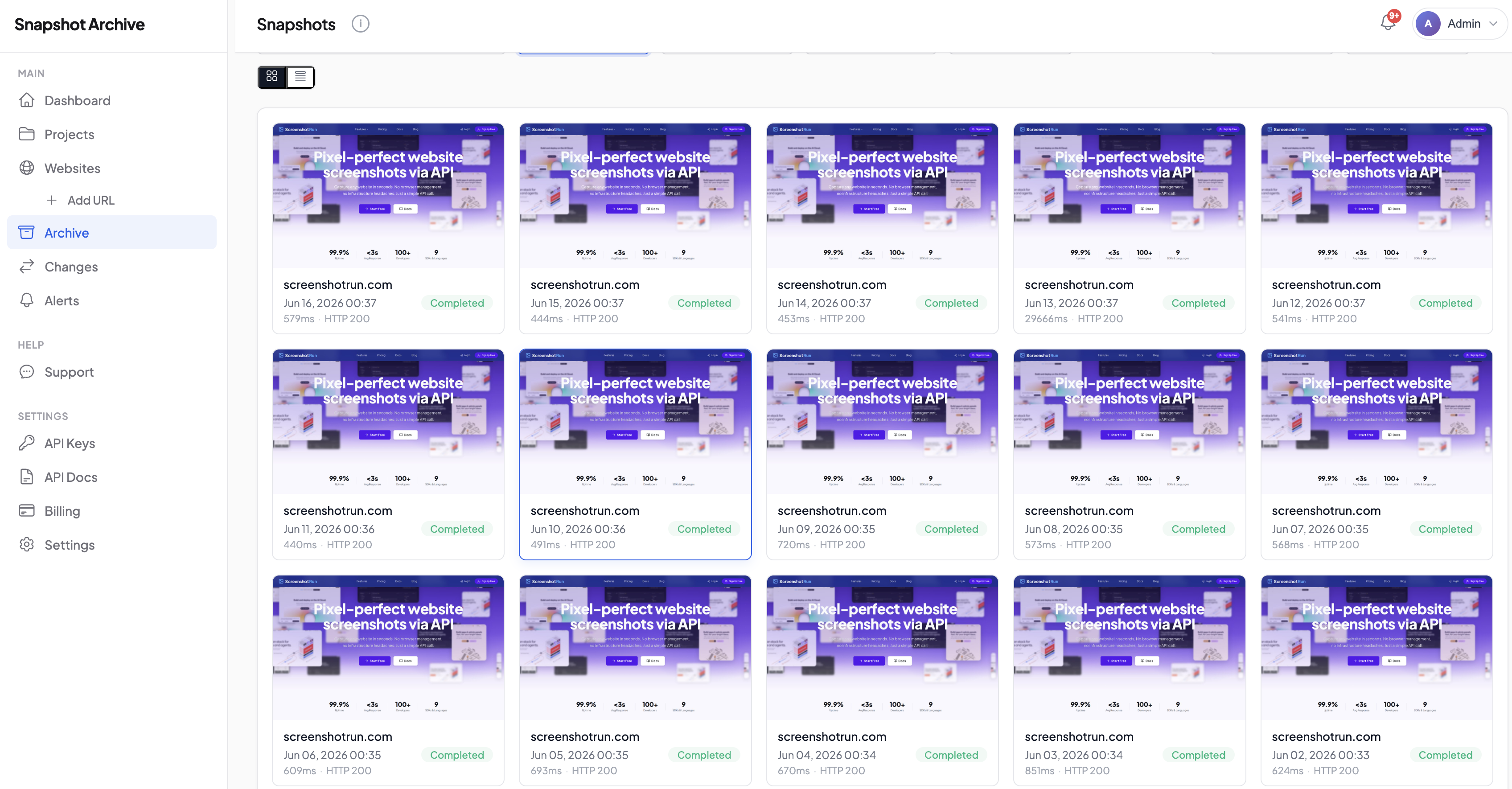
We built Snapshot Archive to close that gap with automated scheduled captures, timestamped watermarks, and SHA-256 certified PDF exports. It won't replace your full regulatory submission system. But for the specific problem of documenting what your public-facing web pages showed on any given date, it does the job at a fraction of what enterprise archiving vendors charge.
Drug labeling goes digital, but the documentation hasn't caught up
Pharma companies spent decades perfecting the paper trail for print materials. Every piece of promotional content gets routed through medical, legal, and regulatory review before it sees daylight. That process works. What doesn't work is what happens after the content goes live on a website.
Consider a branded drug site like the public pages for Humira or Keytruda. These sites carry Prescribing Information links, Medication Guides, fair balance statements, boxed warnings, and promotional claims about efficacy. Labels update frequently, and the web team pushes changes. Sometimes the same day. Sometimes a week later. The old version of the page vanishes. No record of what it showed before. No timestamp. No hash.
Print ads get filed in a vault. TV spots get cataloged. Websites get overwritten.
That asymmetry is what creates risk. OPDP (the FDA's Office of Prescription Drug Promotion) issued 8 warning and untitled letters in 2023 alone for digital promotional content. Each letter references specific claims and specific URLs. If you can't produce an archived version of what appeared on that URL at the time of the alleged violation, your response starts from a defensive position.
What pharma and healthcare companies should be capturing
Website archiving in this industry comes down to the pages that carry regulatory weight. What we see teams prioritize:
Branded drug product pages. Every page that makes an efficacy claim, lists indications, or presents safety information. These are the pages OPDP reviews. Capture frequency matters here: daily is the minimum for actively promoted products, because label updates can trigger same-day web changes.
Fair balance and ISI sections. The Important Safety Information (ISI) block at the bottom of a branded drug page is one of the most scrutinized pieces of content in pharma marketing. When it scrolls, truncates, or renders differently across devices, that's a compliance problem. Full-page screenshots capture the entire ISI as it renders in a real browser, not just the above-the-fold content.
ClinicalTrials.gov listings. Sponsors are required to post results within 12 months of a trial's primary completion date. Archiving your own listings on ClinicalTrials.gov creates a timestamped record of when results were posted, which proves useful if there's ever a dispute about timeliness under FDAAA 801.
Patient-facing and HCP portals. Landing pages for patient assistance programs, HCP education portals, and disease awareness sites all fall under promotional content rules if they're connected to a specific drug. These pages change frequently and rarely get the same compliance attention as the main branded site.
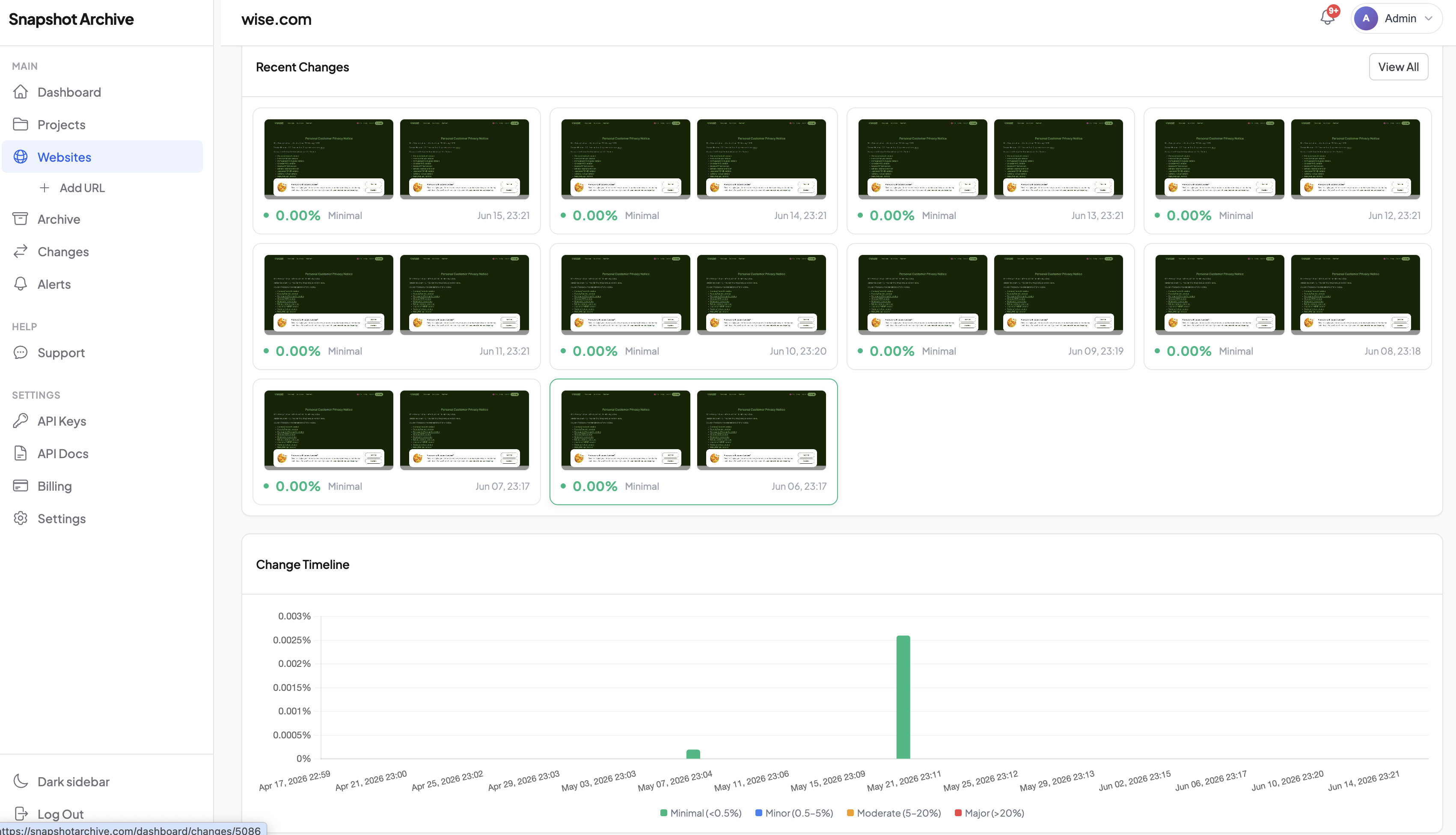
Competitor drug pages. Pharmacovigilance teams monitor competitor labeling for safety signal updates. When a competitor adds a new contraindication or updates their boxed warning, visual diff catches it, often before internal intelligence reports surface the change. Our visual diff runs in three modes (Diff Overlay, Side-by-Side, and Slider), and for label changes, the Diff Overlay mode highlights exactly what moved.
Pharmacy benefit and formulary pages. Payer websites that list your drug's formulary status or step therapy requirements change without notice. Archiving those pages gives market access teams documentation of coverage changes over time.
FDA, FTC, and the regulation layer most teams underestimate
Pharma websites sit at the intersection of multiple regulatory frameworks. Most compliance teams know about OPDP review, but the full picture is wider than that.
FDA drug promotion rules (21 CFR Part 202). Any advertisement for a prescription drug must include the established name, quantitative formula, and a "brief summary" of side effects, contraindications, and effectiveness. Your website counts as an advertisement if it makes product claims. These rules apply to every version of the page, not just the current one, which is precisely why archiving matters.
FTC Section 5. For OTC products, supplements, and health claims not under FDA jurisdiction, FTC Section 5 governs deceptive advertising. The FTC increasingly monitors digital health claims, and their enforcement actions reference archived versions of websites. If you're selling anything with a health claim, automated compliance archiving isn't optional.
EU MDR (Medical Device Regulation 2017/745). Medical device manufacturers selling in the EU must maintain technical documentation that includes all promotional materials. Website content that describes device performance or intended use falls under this requirement. Post-market surveillance obligations under Article 83 add a monitoring layer: you need to document how your claims evolved over time.
21 CFR Part 11. This is the regulation everyone asks about, and we want to be direct: Snapshot Archive supports 21 CFR Part 11 compliance but does not satisfy it on its own. Part 11 covers electronic records and signatures, requiring audit trails, access controls, and system validation. Our SHA-256 hash certificates provide the integrity component (tamper-evident records with cryptographic verification), and our timestamped captures provide the date-certainty component. But Part 11 also requires things like user authentication and validation documentation that sit outside the scope of a screenshot archiving tool. We recommend using Snapshot Archive as one layer in a validated system, not as the entire solution.
That honest assessment matters. Enterprise vendors like MirrorWeb charge $1,000 or more per month and position themselves as complete regulatory solutions. We don't make that claim. What we offer is the visual archiving layer (automated, timestamped, hash-verified) at a price point (starting at $14/month for 20 sites) that makes it practical for mid-size pharma companies, biotechs, and medical device firms that can't justify enterprise archiving contracts.
When Sanofi updated their Dupixent ISI on a Friday afternoon
Here's a scenario that plays out regularly in pharma, and it happened to be the kind of situation that first brought healthcare teams to our platform.
A mid-size biotech (not Sanofi, but watching Sanofi closely) had been manually checking competitor drug pages every Monday morning. Their competitive intelligence analyst would open five or six branded drug sites, scroll through the ISI sections, and note any changes in a spreadsheet. It worked, sort of, until it didn't. Sanofi pushed a significant update to the Dupixent Important Safety Information on a Friday afternoon, adding new adverse reaction data from a post-marketing study. By Monday, the biotech's team saw the updated version but had no record of when the change appeared or what the previous version said.
With daily scheduled captures running across all five competitor branded sites, the Friday capture showed the old ISI and the Saturday capture showed the new one. The visual diff between those two captures highlighted exactly which paragraphs changed. No more Monday-morning guesswork. No more "I think it changed sometime last week." A timestamped, hash-verified record of the before and after.
Their pharmacovigilance team now uses that same capture history to track safety signal updates across competitors. When a new boxed warning appears or an indication gets withdrawn, they have the exact date, which feeds directly into their own regulatory intelligence reports. The change alerts notify them within hours, not days.
The features that matter when the stakes involve patient safety
Healthcare isn't e-commerce. A pricing discrepancy on a product page is a business problem. A missing contraindication on a drug page is a patient safety problem. The features that matter here are the ones that create defensible, date-certain records.
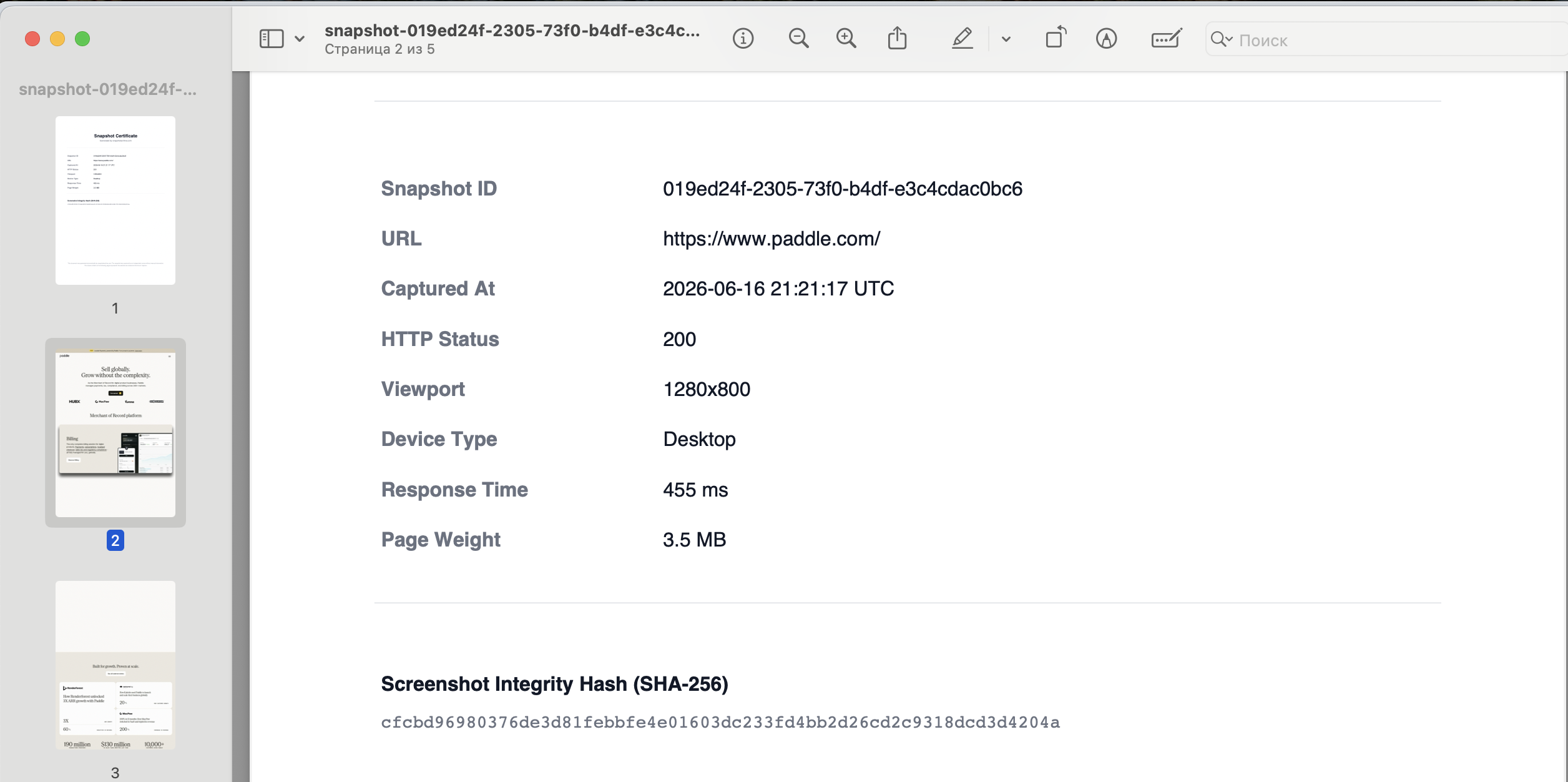
Every PDF export carries a SHA-256 integrity hash, the capture URL, HTTP response code, viewport dimensions, response time metadata, and page weight. If someone questions whether a capture was altered after the fact, the hash settles it. We chose SHA-256 specifically because it's the standard accepted in legal and regulatory contexts, the same algorithm used in digital evidence authentication.
Changes between captures get classified by severity: minor, moderate, or major. A font rendering difference is minor. A restructured paragraph is moderate. A removed warning statement is major. For pharmacovigilance workflows, severity filtering means your team only gets alerted on the changes that actually matter, not every CSS tweak.
Drug pages are long. A Keytruda.com product page runs thousands of pixels. If your archiving tool only captures the viewport, you miss the ISI, the references, the footnotes, exactly the content regulators care about most. Our full-page captures render the entire scrollable page.
Larger pharma teams need captures to flow into document management systems or regulatory information platforms. The Snapshot Archive API (available from the Pro plan) lets you trigger captures programmatically and pull archives into your existing infrastructure. We've seen teams pipe captures into Veeva Vault workflows, though that integration is manual. We don't have a native Veeva connector.
A realistic setup for a mid-size biotech's regulatory affairs team
What does this look like in practice? Here's a configuration based on what we typically see from biotech and pharma teams with 2-4 marketed products:
A typical team monitors 40-60 pages. That breaks down to roughly 8-12 pages per branded product (main page, ISI, prescribing information, patient resources, HCP page), plus 10-15 competitor pages, plus a handful of ClinicalTrials.gov listings and payer formulary pages.
Branded and competitor pages need daily captures because label updates can drop at any time. Formulary pages change less frequently. Weekly is usually enough. We recommend daily over twice-daily unless you're in a period of active label negotiation with the FDA.
For alerts, set the severity threshold to moderate or above on competitor ISI sections and your own branded pages. Minor changes (rendering differences, ad rotation) generate noise. Moderate and major changes (text additions, section removals, warning updates) are what your regulatory team needs to see.
Retention matters here more than in most industries. FDA recordkeeping requirements vary by document type, but for promotional materials, the standard recommendation is to retain records for the duration of the product's marketing plus 2 years. Our Pro plan retains captures for 1 year. Business plan retains for 3 years. For products with long market lives, we recommend the Business tier. See our retention guide for more detail on matching retention periods to regulatory requirements.
When a regulatory affairs team needs to produce records for an OPDP inquiry or an internal audit, they export the relevant date range as PDFs. Each PDF carries the hash, the timestamp, and the capture metadata. That's the package you hand to your regulatory counsel.
What screenshot archiving won't solve in a regulated environment
We've been direct throughout this page, and this section is where we stay direct.
Snapshot Archive captures what a page looks like at a given moment from a single IP address and a single viewport. It doesn't capture dynamic content that requires login credentials (gated HCP portals, for example). It doesn't satisfy submission requirements for FDA Form 2253 (the form pharma companies use to submit promotional materials for OPDP review). And it doesn't provide the chain-of-custody documentation that a full regulatory information management system offers.
Screenshots are captures from one geographic location. If your drug page serves different content based on the visitor's location through geo-targeting, or if it personalizes content based on cookie data, those variations won't appear in a standard capture. This is a limitation of any screenshot-based archiving tool, not just ours.
We also don't archive video content. If your DTC campaign includes embedded video on the product page, the capture will show the video thumbnail or player, not the video itself. For video archiving, you need a different solution.
Where Snapshot Archive fits is in the visual documentation layer: proving what a page displayed, when it displayed it, and providing a tamper-evident record of that state. For many healthcare and pharma teams, that layer is the one they're currently missing entirely. Or they're handling it with manual screenshots that carry no metadata, no hash, and no defensible timestamp. Our legal evidence documentation explains the evidentiary standards in more detail.
How this connects to compliance workflows you're already running
If you're already archiving social media posts (most pharma companies are, because OPDP monitors those too), website archiving follows the same logic. The difference is that social media archiving tools like Smarsh and Proofpoint already exist as mature platforms. Website archiving for mid-market pharma has been a gap. The enterprise tools cost too much, and the Wayback Machine isn't built for compliance. It captures sporadically, you can't control the schedule, and it provides no integrity verification.
Snapshot Archive sits alongside your existing compliance stack the way automated captures replace manual ones: by removing the human bottleneck without replacing the human judgment. Your MLR (Medical, Legal, Regulatory) review process stays the same. Your promotional material submission process stays the same. What changes is that you now have an automated, timestamped record of what actually appeared on the live site after it passed through review.
That distinction matters more than it sounds. MLR review approves what should go live. Archiving documents what did go live. Those aren't always the same thing, and when they diverge (a web team deploys a draft version, a CMS update breaks formatting, a third-party widget injects unexpected content), the archive is what proves it. Teams working in financial services and legal firms use the same principle, but the stakes in healthcare are different. A compliance gap in financial services is a fine. A compliance gap in pharma could mean patients receive inaccurate safety information.
For teams tracking terms of service or privacy policy changes on third-party platforms that host your content (pharmacy benefit managers, telehealth platforms, patient coupon sites), our policy tracking guide covers the setup in detail.
We recommend starting with your highest-risk pages: the branded product page for your top-revenue drug and two or three competitor equivalents. Set up daily captures, enable change alerts at moderate severity, and run it for two weeks. You'll quickly see the pattern of changes that your current process misses. From there, expand to the full list.
Start archiving websites today
Free plan includes 3 websites with daily captures. No credit card required.
Create free accountFrequently Asked Questions
Snapshot Archive supports 21 CFR Part 11 compliance but does not satisfy it on its own. Our SHA-256 hash certificates provide the integrity component with tamper-evident, cryptographically verified records, and our timestamped captures provide date-certainty. However, Part 11 also requires user authentication, audit trails, access controls, and system validation documentation that sit outside the scope of a screenshot archiving tool. We recommend using Snapshot Archive as one layer in a validated compliance system.
For actively promoted branded drug pages and competitor drug pages, we recommend daily captures at minimum. Label updates from the FDA can trigger same-day web changes, and daily captures ensure you have a record of what the page showed before and after any update. For formulary pages and ClinicalTrials.gov listings that change less frequently, weekly captures are usually sufficient.
No. Snapshot Archive captures publicly accessible web pages from a single IP address and viewport. It does not support authentication or login credentials. For gated HCP portals, patient portals behind login walls, or any content that requires session cookies to access, you would need a different archiving solution or internal screenshot process.
Visual diff compares consecutive captures of the same page and highlights what changed. Changes are classified by severity: minor (rendering differences), moderate (restructured content), or major (removed warnings, new contraindications). Pharmacovigilance teams can set alerts to trigger only on moderate or major changes, filtering out noise from CSS tweaks and ad rotation. The three comparison modes — Diff Overlay, Side-by-Side, and Slider — let analysts see exactly what moved in competitor drug labeling.
Most pharma teams monitoring 40-60 pages need the Pro plan ($39/month) for API access and 1-year retention, or the Business plan ($129/month) for 3-year retention. FDA recordkeeping recommendations for promotional materials suggest retaining records for the duration of a product's marketing plus 2 years, so the Business plan is the better fit for products with long market lives.
SHA-256 is a cryptographic standard widely accepted in legal and regulatory contexts for verifying document integrity. Each PDF export from Snapshot Archive carries the SHA-256 hash, capture URL, HTTP response code, viewport dimensions, response time, and page weight. These tamper-evident records demonstrate that a capture has not been altered after the fact. While we cannot guarantee how any specific regulatory body will evaluate evidence, SHA-256 verification is the same standard used in digital evidence authentication across legal proceedings.
There is no native Veeva Vault connector, but the Snapshot Archive API (available from the Pro plan) allows you to trigger captures programmatically and retrieve archived screenshots and PDFs. Teams have built manual integrations that pipe capture data into Veeva Vault workflows. The API returns capture metadata including timestamps and SHA-256 hashes, which can be stored alongside the archived files in your document management system.