
Terms of Service & Privacy Policy Tracking
Your vendors change their Terms of Service and Privacy Policy pages without telling you. A payment provider quietly updates where they process customer data. A cloud hosting partner modifies their SLA uptime guarantee. An analytics tool rewrites their data retention clause. Without a way to track privacy policy changes or monitor terms of service updates, you're operating under terms you never reviewed. And your compliance posture depends on what those documents say.
Snapshot Archive lets you monitor terms of service changes and track privacy policy changes automatically. Add any vendor's ToS or Privacy Policy URL, set a daily capture schedule, and let visual diff flag the exact clause that changed. When a policy page shifts (a new data processing jurisdiction, a removed refund guarantee, a changed liability cap) you get an alert with dated captures showing the before and after. No manual checking, no missed updates, no compliance surprises during your next audit.
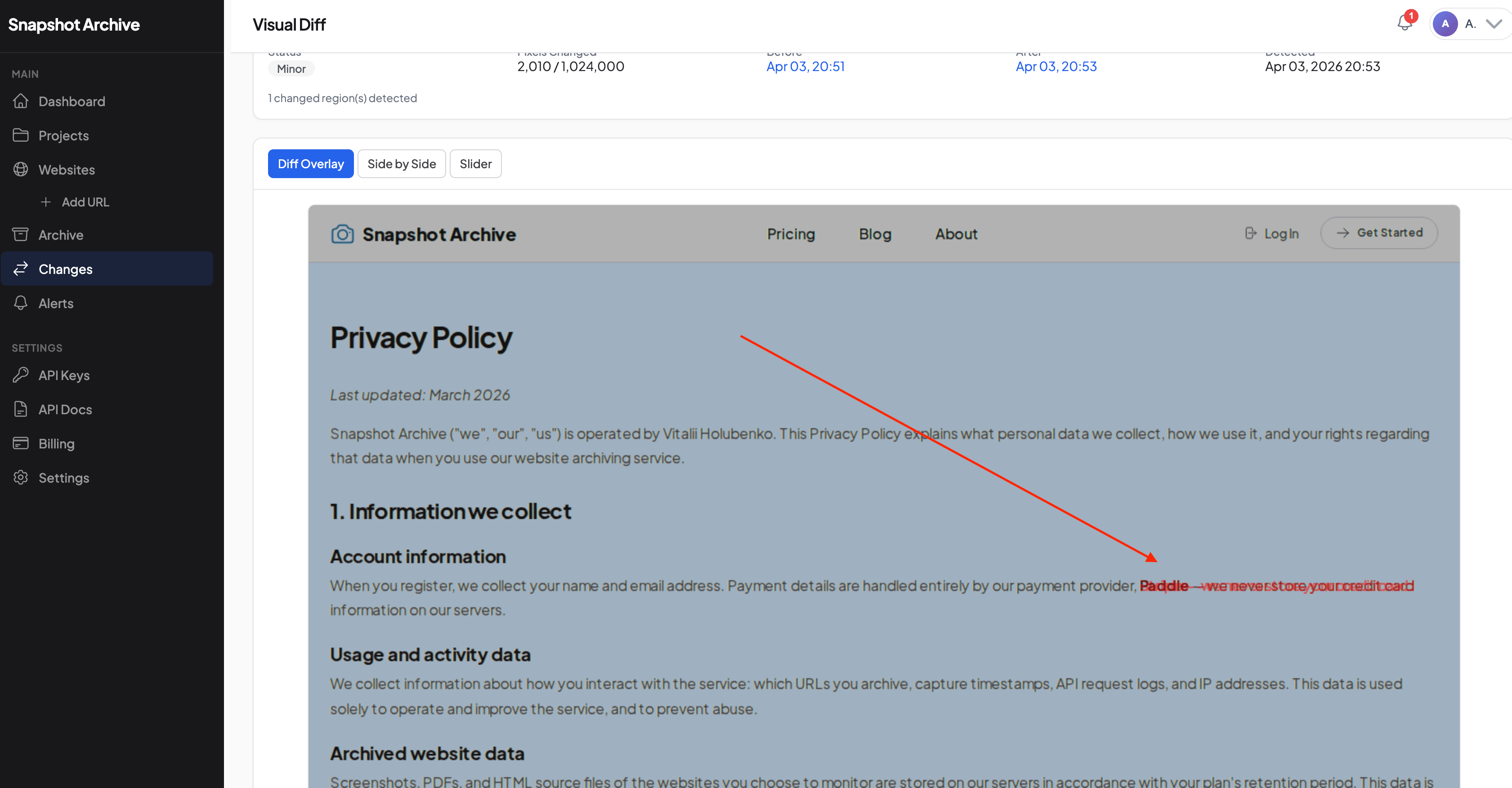
Vendor policy changes create liability you're already exposed to
Terms of Service and Privacy Policy documents are legally binding. When you click "I agree" during vendor signup, you accept everything written in them. When the vendor changes those documents three months later, you're bound by the updated version whether you noticed the change or not. Most vendors include a clause that says you're responsible for periodically checking for updates. A requirement that's unrealistic when your company relies on twenty or thirty SaaS vendors.
The risk is concrete. A payment provider changes where they process data, and your Privacy Policy still promises EU-only processing to your customers. That's a GDPR or CCPA compliance gap created by someone else's update to a document you never re-read. A cloud hosting partner lowers their SLA from 99.99% to 99.9% uptime, and your own SLA to customers still references the old number. Without vendor policy monitoring in place, these risks compound silently across your entire vendor stack.
In regulated industries: legal, financial services, healthcare, the stakes are higher. Auditors expect documented evidence that you monitor third-party agreements. "We were keeping an eye on it" is not documentation. Dated visual captures of policy pages, with visual diff showing exactly what changed and when, is the level of evidence that satisfies audit requirements. Automated policy monitoring is a core component of third-party risk management (TPRM.) and the alternative is hoping nothing important changed. If your concern is specifically around cookie consent banners and GDPR, cookie compliance monitoring covers that angle.
Visual diff for terms of service pages: what text monitoring misses
Most policy monitoring tools: Visualping, TOSTracker, PageCrawl, use text-based change detection. They download the page's HTML, compare it to the previous version, and show which words were added or removed. This works for straightforward text edits, but it has structural blind spots.
When a vendor restructures their Privacy Policy into collapsible sections, moves a critical clause from the top to the bottom, or hides a paragraph behind a "Show more" link, layout-focused changes go undetected. The text is technically still there, but its visibility and prominence changed. Something text diff can't surface.
CSS and formatting changes are equally invisible to HTML comparison. A vendor makes a liability limitation clause smaller, lighter, or visually de-emphasized. The legal weight is unchanged, but the intent to obscure is clear: and only a visual comparison catches it. In a legal context, how terms are presented matters as much as what they say.
JavaScript-rendered content creates the biggest gap. Some companies load their legal documents dynamically, pull content from a CMS, or render terms through embedded widgets. Text monitoring that parses only the source HTML sees an empty container. Automated screenshot monitoring for legal documents captures the fully rendered page, exactly what a visitor or signatory sees in their browser.
Snapshot Archive takes full-page screenshots of every policy page, renders JavaScript, loads fonts and images, and runs pixel-level comparison. A one-word change in paragraph fifteen of a twenty-section Terms of Service shows up as a 0.2% pixel difference. Small enough to filter out rendering noise, significant enough to flag a real edit. Visual diff for terms of service pages shows the before-and-after state of a specific clause in context, not as raw HTML markup requiring mental rendering.
Automated policy monitoring: which documents to track and how often
Tier 1: daily monitoring. Vendors that handle your customer data: payment processors (Stripe, PayPal, Paddle), cloud infrastructure (AWS, Hetzner, DigitalOcean), email services (SendGrid, Mailgun), analytics platforms (Google Analytics, Mixpanel). Their Privacy Policy and Data Processing Agreement (DPA) directly affect your compliance claims. A change here can invalidate promises you've made to your own customers, and unlike an RSS feed or email notification from the vendor, automated captures guarantee you never miss an update.
Tier 2. Weekly monitoring. SaaS tools in your stack that don't handle customer PII but have Terms of Service that affect your operations: project management tools, design software, CI/CD platforms. Changes to usage limits, pricing tiers, or acceptable use policies can impact your workflow without warning.
Tier 3: weekly or biweekly. Competitor legal pages. Competitor Terms of Service sometimes reveal product changes before they hit the landing page, a new pricing tier, a feature limitation, an SLA change often appears in the terms first, because legal teams work ahead of marketing teams. A competitor removes their free tier from their Terms of Service, and your comparison page still advertises it. that's the kind of gap this tier catches.
Your own documents. Monitor your own Terms of Service and Privacy Policy as a baseline. This creates a timestamped archive proving what your documents said on any specific date: essential for dispute resolution and compliance archiving.
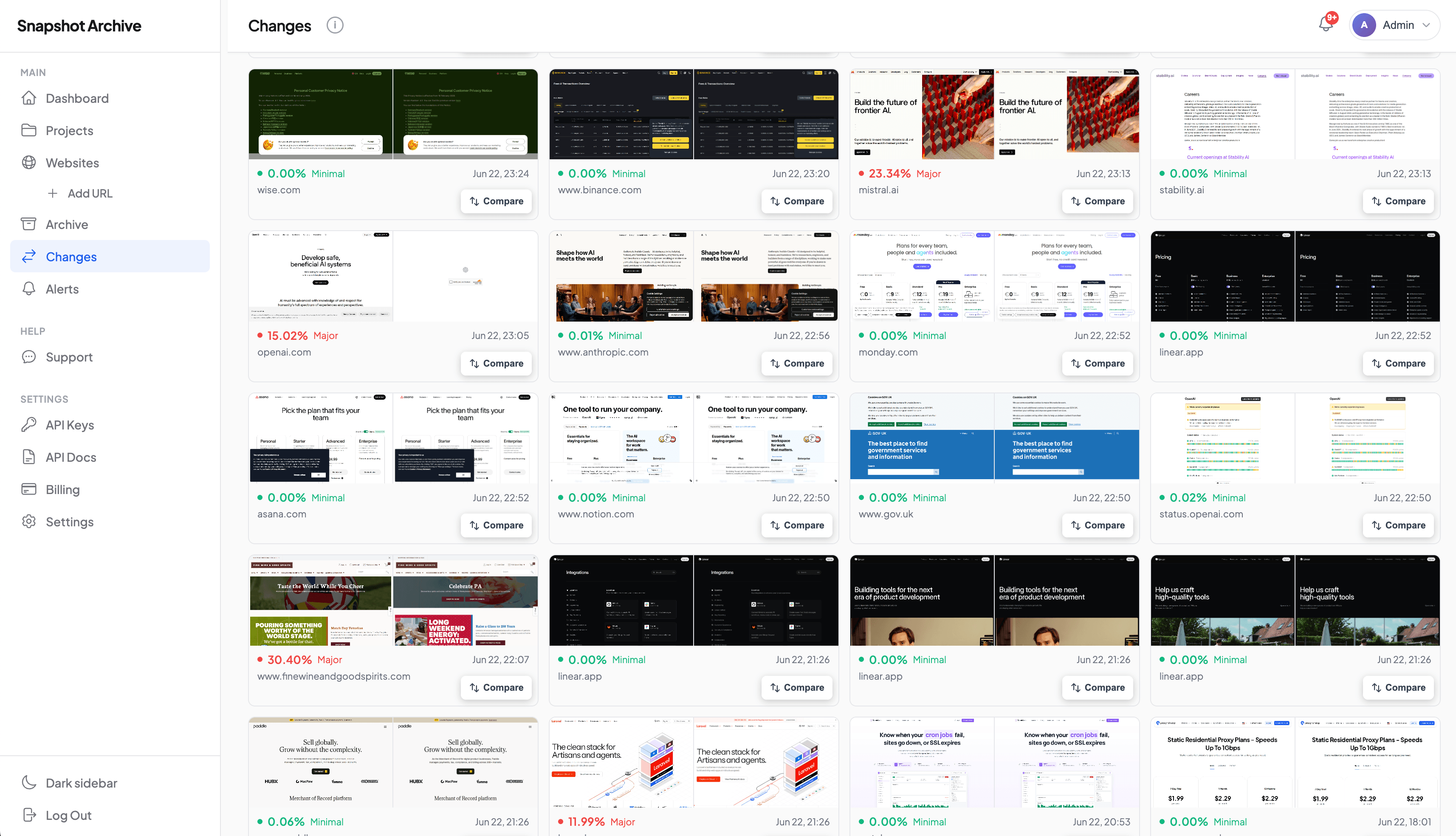
How to set up policy monitoring in five minutes
Add your first vendor's Terms of Service URL and enable full-page capture, legal documents are long, and without it you only capture the visible viewport, missing changes buried in section fifteen. Set the frequency to daily for critical vendors.
Enable change detection with a 0.1% threshold. Legal pages are static. Any pixel change almost certainly means a real text edit, not rendering noise. For pages with cookie banners or dynamic headers, raise the threshold to 0.5%, or use a clip-to-element selector to exclude the banner area from comparison. If a vendor updates their copyright year in the footer or rotates a cookie consent banner, the threshold filters that out while still catching substantive edits to policy text.
Route alerts to your legal or compliance team's channel: Slack, email, or a webhook endpoint. When a vendor updates their policy, the notification arrives with a direct link to the visual diff showing exactly which section changed, with timestamps on both versions.
Add more URLs as needed. Most teams start with five to ten critical vendor policies and expand from there. The REST API supports bulk URL management if you need to onboard dozens of vendor documents at once. Within five minutes you have a working terms of service change tracker covering your most critical vendors.
From policy change detection to audit-ready evidence
Every capture becomes part of a timestamped visual archive. After six months of daily monitoring, you have a complete version history for every vendor's legal documents: when each change occurred, what the page looked like before and after, and the percentage of the page that was modified.
During a GDPR or SOC 2 audit, this archive answers the question auditors actually ask: "How do you monitor changes to your data processors' agreements?" Instead of "we check periodically," you show a dashboard with documented captures, automated alerts, and visual diffs proving you detected and responded to every change. Auditors can see the difference between a claim and a documented process, and so can regulators.
For legal disputes, timestamped screenshots serve as proof of what terms were in effect on a specific date. A PDF export with SHA-256 hash provides a tamper-evident snapshot certificate that can be submitted as documentary evidence. We covered the legal requirements in detail in our article on using screenshots as legal evidence.
The same archive serves procurement teams during vendor reviews. Before renewing a contract, pull up the vendor's policy change history. How many times did their terms change in the past year?
Did any changes affect data processing, liability, or pricing? A vendor that quietly modifies their Terms of Service every quarter warrants a different conversation than one whose documents haven't changed in two years.
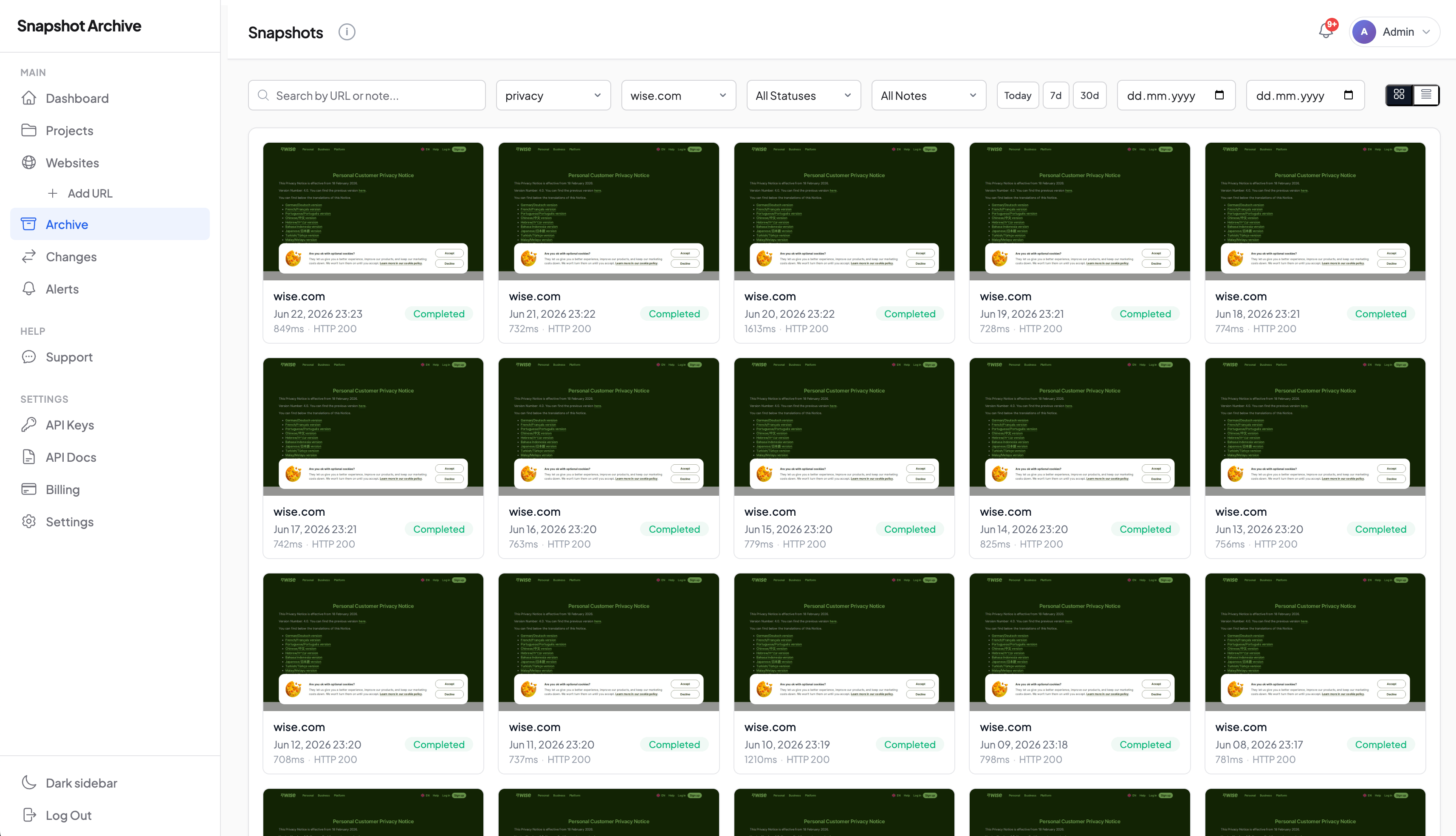
Policy monitoring across regulated industries
Financial services vendors fall under regulatory oversight that extends to their agreements. SEC Rule 17a-4, FINRA requirements, and MiFID II all mandate record-keeping for communications and agreements with service providers. Automated screenshot archives of vendor policy pages (with timestamps and policy change detection backed by timestamped visual evidence) satisfy the documentation requirements that manual processes cannot.
Healthcare and pharma organizations face a specific version of this problem. HIPAA Business Associate Agreements (BAAs) define how vendors handle protected health information. A vendor changing BAA terms without proper notification is a compliance event requiring a documented response. Visual monitoring catches these changes the day they happen, not months later during an annual review.
Law firms monitoring client-relevant vendor policies gain a service differentiator. Proactive alerts about changes to a client's vendor terms demonstrate ongoing oversight that clients expect from outside counsel.
E-commerce sellers feel this most acutely on marketplaces. Amazon, Shopify, and eBay update their seller agreements frequently, and a missed change to commission rates, return policies, or listing requirements can cost thousands before anyone notices. Pair this with price monitoring to catch both policy and pricing shifts.
Start archiving websites today
Free plan includes 3 websites with daily captures. No credit card required.
Create free accountFrequently Asked Questions
Add the vendor's Terms of Service URL to Snapshot Archive, set daily captures with full-page screenshots enabled, configure change detection with a 0.1% threshold, and route alerts to your legal or compliance team via Slack, email, or webhook.
Snapshot Archive captures full-page screenshots of privacy policy pages on a schedule and uses pixel-level visual diff to detect changes — including layout shifts, CSS formatting changes, and JavaScript-rendered content that text-based monitoring tools miss.
Yes. Timestamped screenshots with SHA-256 hash certificates serve as documentary evidence of what a page displayed on a specific date. PDF exports with hash verification provide tamper-proof snapshot certificates suitable for legal proceedings and compliance audits.
Daily for vendors handling customer data (payment processors, cloud infrastructure, analytics platforms). Weekly for operational SaaS tools that don't process PII. Biweekly for competitor legal pages and non-critical vendor policies.
Text-based tools compare HTML source code and show word-level additions or removals. Visual diff compares rendered screenshots pixel by pixel, catching layout restructuring, CSS formatting changes, content hidden behind collapsible sections, and JavaScript-rendered updates that text monitoring cannot detect.
GDPR requires documented evidence that you monitor data processors' agreements. Automated screenshot archives with change detection and timestamped visual diffs satisfy this requirement by providing audit-ready proof that you detected and responded to every vendor policy change.