
Website Archiving for Trademark & IP Law
Trademark watch services scan filings, domain registrations, and application databases. They flag new marks that look confusingly similar to your client's. What none of them do is monitor the actual website where the infringement is happening. A knockoff brand launches a product page on Shopify. A domain squatter puts up a landing page with your client's logo. A reseller on Amazon swaps the listing images. These changes happen on live web pages, and website archiving for trademark law is how you capture them before they disappear.
The gap between filing-based watch services and what's actually visible on the web is where most trademark evidence falls apart. Corsearch and Clarivate will tell you that someone filed a similar mark in Class 25. They won't tell you that the same party has been selling infringing goods on eBay for six weeks with your client's trade dress in the product photos. We built Snapshot Archive with this problem in mind: automated, scheduled captures of live web pages, each one timestamped and certified with a SHA-256 hash, so the record exists when you need it for a TTAB proceeding, a UDRP complaint, or a Lanham Act claim.
What trademark watch services miss and why live website monitoring fills the gap
Traditional watch services operate at the registry level. They monitor trademark filings at the USPTO, EUIPO, WIPO, and national offices worldwide. Some extend into domain name registrations through ICANN's WHOIS data. A few scan social media handles. All of that matters, but none of it captures what a potential infringer is actually doing on their website.
Consider a scenario we see regularly. A brand protection team uses a watch service that flags a new domain registration containing their client's mark. The domain resolves to a parked page. Six weeks later, the registrant builds out a full e-commerce site with product listings, client logos, and pricing that undercuts the genuine goods. The watch service flagged the domain on day one, but nobody captured the site content as it evolved. By the time counsel sends a cease-and-desist, the respondent takes the site down, and the only evidence of what it showed is someone's memory.
Scheduled captures running daily or weekly on suspected domains solve this. Every version of the page gets stored with its timestamp, HTTP response code, and page weight. When the site goes dark, the archive stays. You can walk through the timeline showing exactly when infringing content appeared, what it looked like, and how long it was live.
UDRP, TTAB, and Lanham Act: the evidence requirements that shape how you archive
Different proceedings impose different standards on web-based evidence, and those differences should shape how you set up your monitoring.
In UDRP proceedings (the domain dispute process administered under ICANN rules), panels routinely evaluate website content to determine whether a domain was registered and used in bad faith. Respondents know this. A common tactic is to take down or change the site content after receiving a complaint. If you filed the complaint relying on what the site showed last Tuesday, and the respondent swapped it to a blank page by Thursday, your evidence is gone unless you archived it. WIPO panels accept timestamped screenshots, but the weight they carry depends on whether the panel trusts their authenticity. A PDF certificate with a SHA-256 hash (cryptographic proof that the content hasn't been altered since capture) gives you stronger footing than a browser screenshot pasted into a Word document.
TTAB proceedings before the USPTO follow federal rules of evidence more closely. In opposition and cancellation actions, parties submit evidence of use, likelihood of confusion, and fame. Dated website printouts are common exhibits. But the Trademark Trial and Appeal Board has rejected screenshots that lack reliable timestamps or chain-of-custody metadata. In Cristo v. Cayabyab, the Board scrutinized the reliability of internet evidence and noted that undated or poorly sourced printouts carry little probative value. Moroccanoil Israel Ltd. v. Marc Anthony Cosmetics, Inc. saw similar issues when screenshots lacked sufficient foundation. These aren't obscure edge cases. They're warnings about what happens when your evidence is a JPEG with no metadata.
Lanham Act Section 43(a) claims in federal court raise the bar further. Trade dress infringement cases, for example, often require showing how an infringing product's packaging or website presentation evolved over time. A single snapshot proves a moment. A visual diff timeline proves a pattern: when the respondent adopted confusingly similar trade dress, whether they moved closer to or further from your client's look, and how the infringing presentation changed after receiving notice. Courts want to see the trajectory, not just a freeze-frame.
Counterfeiting on Amazon, eBay, and AliExpress moves faster than your legal team
E-commerce counterfeiting has its own rhythm. A counterfeit listing appears on Amazon, gets reported through Brand Registry, and disappears within 48 hours. The seller opens a new account and relists the same product under a different ASIN. On eBay, VeRO takedown requests remove listings, but the same photos and descriptions resurface from a different seller ID within days. AliExpress and the Alibaba IP Protection Platform process complaints, but the turnaround gives sellers time to move inventory and delete evidence.
If your only record of the infringing listing is Amazon's "this page no longer exists" message, you have nothing to show a court. Archived captures of the listing page, the seller's storefront, and the product images give you a dated record that survives the takedown cycle. We recommend setting daily captures on high-priority counterfeiting targets. The captures run whether the listing stays up or not, so you catch the content while it's live.
One pattern we've noticed: counterfeiters often test listings with low inventory before scaling up. The initial listing might show 5 units available with one product image. A week later, the same listing has professional photography, dozens of reviews, and international shipping. That escalation timeline matters in damages calculations and willfulness arguments. Without dated archives, you can't reconstruct it.
Building a timeline of infringement before the cease-and-desist
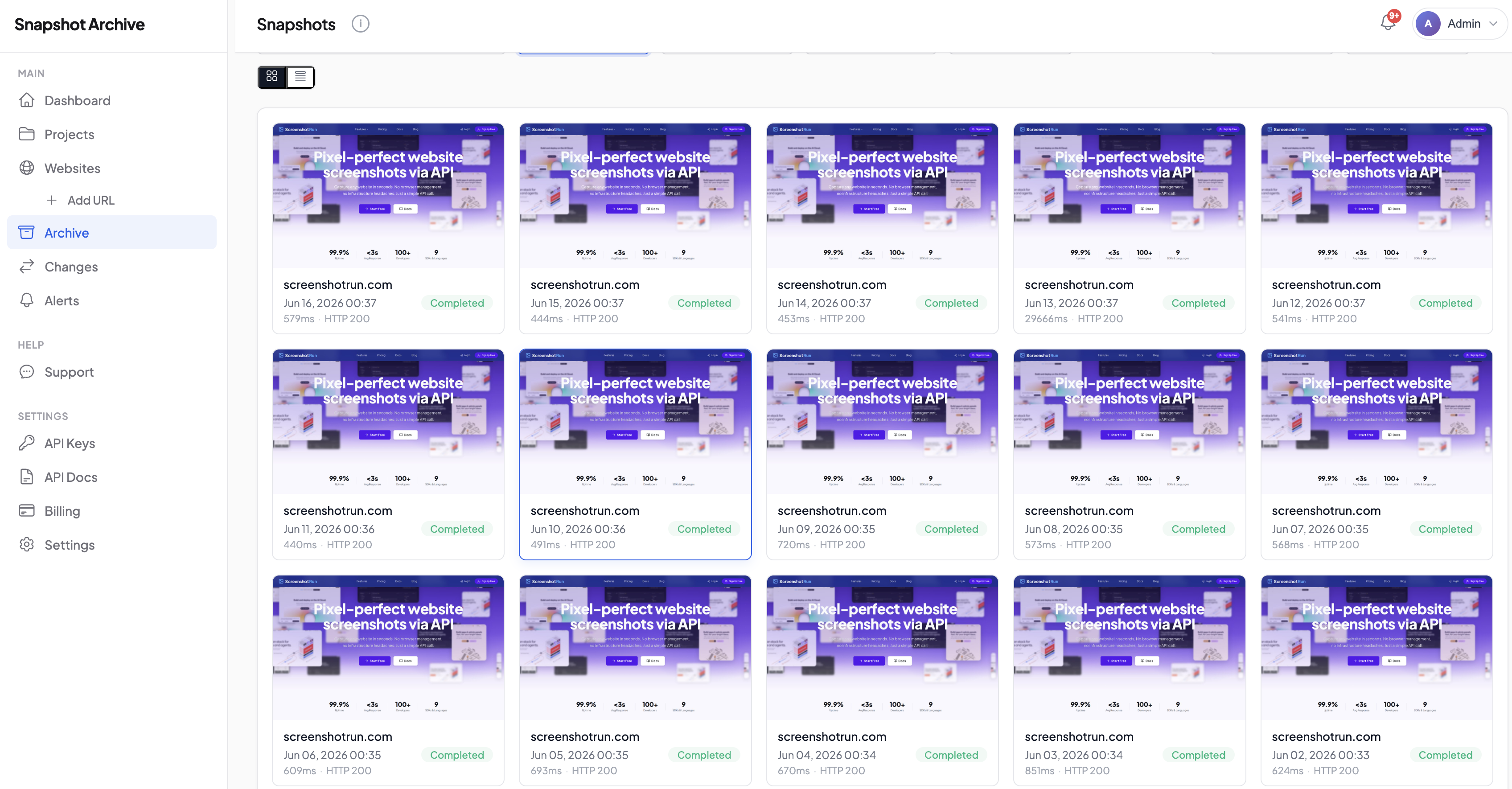
Cease-and-desist letters work better when they come with evidence attached. A letter that says "your website infringes our client's trademark" invites denial. A letter that includes timestamped screenshots from four different dates, showing the progression of infringing content, invites a settlement conversation.
Start archiving suspected sites before you send the letter. We've seen cases where counsel waited to begin monitoring until after the C&D went out, only to find that the infringer immediately took down the offending content. The pre-notice archive is often the most valuable because it captures the infringement in its natural state, before the other side starts scrubbing.
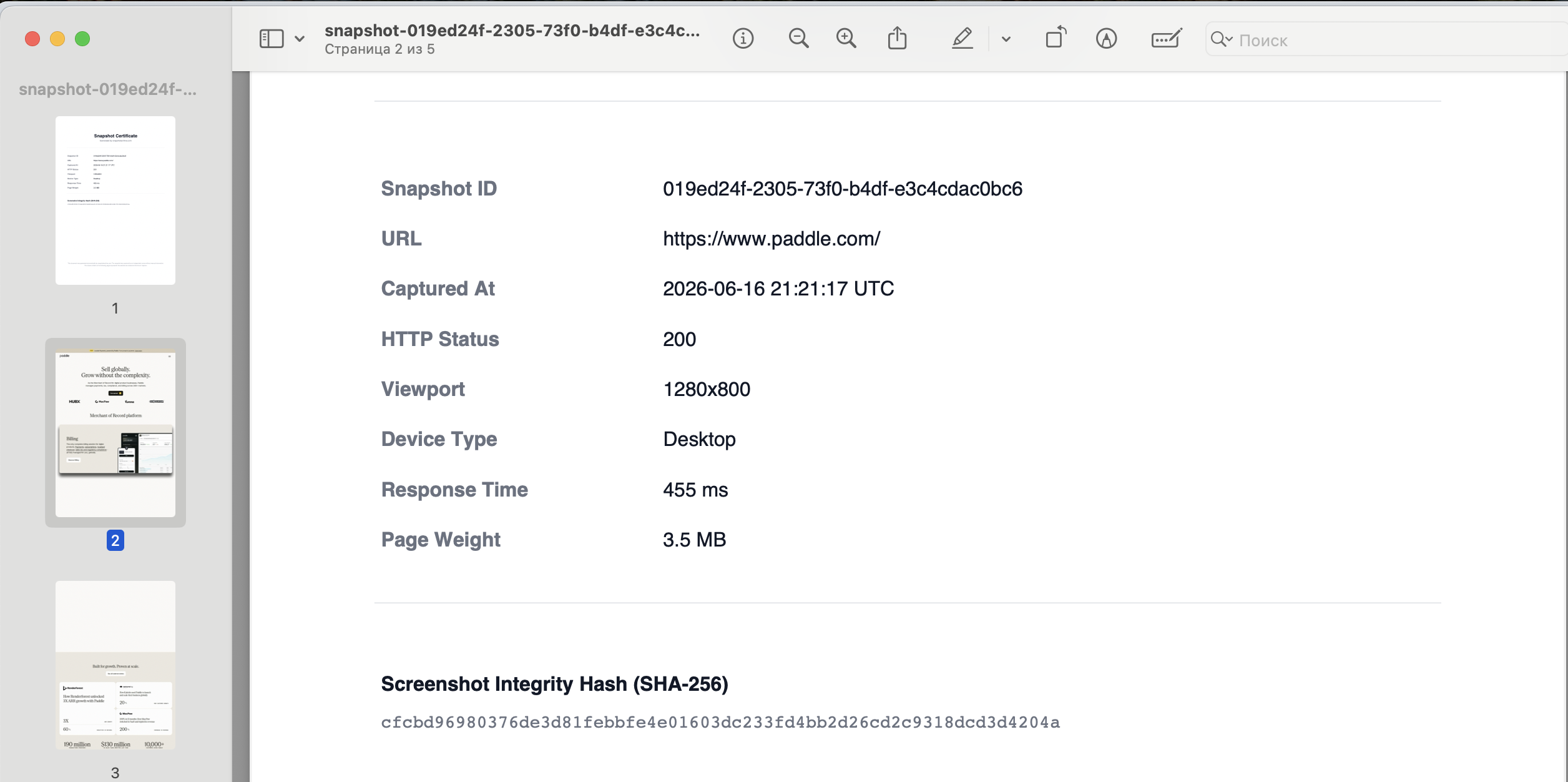
With Snapshot Archive, each capture generates a watermarked screenshot showing the date, time, and URL directly on the image. The accompanying PDF certificate includes the SHA-256 hash, HTTP response code, viewport dimensions, response time, and page weight. That metadata package answers the foundation questions a court will ask: when was this captured, from where, and how do we know it hasn't been altered?
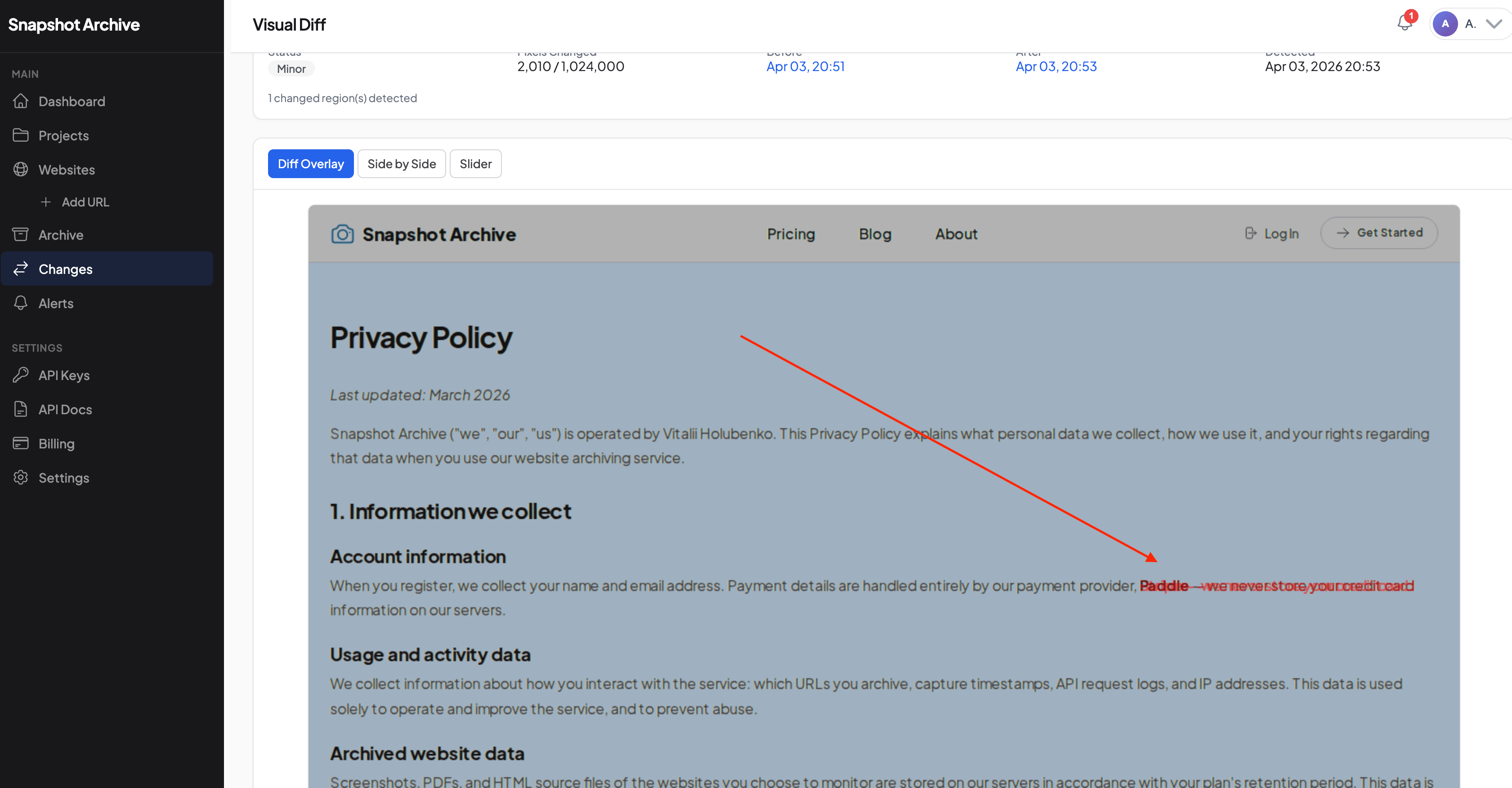
Visual diff adds another layer. Set up monitoring on the target site, and the system compares each new capture against the previous one. Three comparison modes handle different scenarios: Diff Overlay stacks both snapshots and highlights changed pixels, Side-by-Side places them next to each other, and Slider lets you drag across the boundary. Changes get classified into three severity levels (minor, moderate, major), so your team gets alerted only when something meaningful shifts.
DMCA takedowns and the screenshots you'll wish you had
DMCA takedown notices follow a pattern that makes archiving especially important. You identify infringing content, send the notice, the hosting provider removes it, and the infringer either files a counter-notice or re-uploads the same content from a different location. Without archived evidence of each cycle, you're filing repeat notices that reference content nobody can verify existed.
Re-uploads after takedown are common enough that we built change detection alerts partly with this scenario in mind. Set up monitoring on a URL where you've issued a takedown. If new content appears, you get an alert. The capture is already stored before you even see the notification. That record of removal and re-upload strengthens your case for willful infringement and repeat offender status under the DMCA's safe harbor provisions.
For content hosted on platforms like YouTube, Instagram, or TikTok, the takedown-and-reappear cycle moves even faster. Archiving the original infringing post, the takedown confirmation, and any re-uploads creates a paper trail that platform-level dispute tools don't preserve on their own.
What trademark monitoring with Snapshot Archive looks like in practice
A typical IP monitoring setup covers four categories of URLs, and each one calls for a different capture frequency and alert configuration.
Suspected infringing domains get daily captures with change alerts enabled. These are the domains your watch service flagged or that you found through manual research, and daily frequency catches content changes before the site owner can react to your legal moves. E-commerce counterfeit listings on Amazon, eBay, Etsy, and AliExpress also run daily. Set the severity threshold to moderate so you're alerted when product images or descriptions change, not when the platform shifts its layout.
Your client's own brand pages need weekly captures for defensive monitoring, confirming that trademarks are being used consistently and that no unauthorized third party has inserted affiliate links or altered brand assets. Competitor marketing pages get weekly or biweekly captures for trade dress and comparative advertising monitoring, where visual diff catches when a competitor's packaging or website presentation drifts toward your client's protected elements.
On our Starter plan at $14/month, you can monitor 20 URLs with 90-day retention. That covers a typical small-to-mid-size trademark portfolio's active monitoring needs. For firms managing larger portfolios or running long-duration litigation, the Pro plan at $39/month handles 50 URLs with one year of retention and includes API access for integrating captures into your case management workflow. The Business plan at $129/month extends retention to three years and covers 200 URLs.
Every capture produces a full-page screenshot with a watermark timestamp and a downloadable PDF certificate. The certificate carries the SHA-256 hash, the URL, the HTTP response code, viewport size, response time, and page weight. For TTAB filings and court submissions, these certificates provide the metadata foundation that bare screenshots lack.
The limits: what screenshot archiving can and can't prove in IP disputes
We want to be direct about what automated screenshot archiving does and doesn't do in a legal context, because overclaiming helps nobody.
SHA-256 hashing proves that the captured content hasn't been altered since the moment of capture. It does not prove that the content on the live website was identical to what our renderer saw. Sites that serve different content to different visitors (based on geolocation, user agent, or cookies) will produce captures that reflect one version of the page, not necessarily the version your opposing party saw. If geo-targeted content matters to your case, you'll need to account for that in your evidence strategy.
A SHA-256 certificate is not the same as a notarized screenshot or a declaration under penalty of perjury. Some jurisdictions and proceedings give more weight to notarized captures or third-party forensic services like Page Vault or Hanzo. We provide the technical integrity layer, the hash that proves the file hasn't been modified, but the legal foundation (authentication, admissibility arguments, expert testimony) is your team's responsibility. This is not legal advice, and we don't pretend it is.
Automated captures also can't interact with pages. If infringing content sits behind a login, inside a JavaScript modal that requires a click, or in a video that needs to play, a static screenshot won't capture it. For those situations, you'll need a manual forensic capture tool or a deposition. We handle the publicly accessible, visible-on-load content that makes up the vast majority of trademark evidence needs.
There's one more practical limit worth mentioning. Screenshot evidence works best as part of a larger evidentiary package. Pair archives with purchase records, WHOIS data, correspondence, and witness declarations. The screenshots show what was on the page. The surrounding evidence shows what it means. Courts give more weight to evidence in context than to screenshots standing alone.
If you're monitoring domains for trademark infringement or archiving e-commerce listings for counterfeiting cases, start with the sites that matter most and let the visual diff flag when something changes. The free plan covers three sites with 30-day retention, enough to test whether automated archiving fits your workflow before committing to a paid tier. For questions about how other legal teams use Snapshot Archive, the industry page for law firms covers the broader setup, while the legal evidence use case page walks through the SHA-256 certification in more detail.
Start archiving websites today
Free plan includes 3 websites with daily captures. No credit card required.
Create free accountFrequently Asked Questions
Yes, but their evidentiary weight depends on authentication. Courts and the Trademark Trial and Appeal Board (TTAB) have rejected screenshots that lack reliable timestamps or chain-of-custody metadata — as seen in Cristo v. Cayabyab and Moroccanoil v. Marc Anthony Cosmetics. SHA-256 hash certificates, timestamped watermarks, and capture metadata (URL, HTTP response code, viewport dimensions) strengthen the foundation of screenshot evidence significantly.
Set up automated daily captures on the infringing URL using a screenshot archiving tool. Each capture should produce a timestamped screenshot and a PDF certificate with a cryptographic hash proving the content hasn't been altered. Archive the site before sending a cease-and-desist letter, as infringers often take down content once notified. The pre-notice archive is typically the most valuable evidence.
Combine a traditional trademark watch service (which monitors filings and domain registrations) with live website monitoring. Watch services flag new marks in registries but don't capture what's actually on the website. Automated screenshot archiving with visual diff fills that gap by capturing live web pages on a schedule and alerting you when content changes — catching when a competitor adopts confusingly similar trade dress or a counterfeit listing appears.
The statute of limitations for trademark infringement varies by jurisdiction, typically ranging from 3 to 6 years in the United States. Retain archived evidence for at least the duration of any active dispute plus the applicable limitations period. Snapshot Archive offers 90-day retention on the Starter plan, 1-year on Pro, and 3-year retention on Business — the Business plan aligns best with long-duration trademark litigation.
Yes. The Trademark Trial and Appeal Board requires that internet printouts submitted as evidence display the date they were accessed and the URL. Undated or poorly sourced printouts carry little probative value. Snapshot Archive's watermark timestamps display the capture date, time, and URL directly on each screenshot, and the accompanying PDF certificate adds SHA-256 verification and additional metadata.
Visual diff comparisons can support likelihood-of-confusion arguments by documenting how a competitor's website or product presentation evolved over time to become more similar to your client's protected trade dress. A timeline of captures showing progressive adoption of confusingly similar elements strengthens the argument that the infringement was deliberate rather than coincidental.
A strong cease-and-desist package includes timestamped screenshots of the infringing website from multiple dates showing the progression of infringing content, PDF certificates with SHA-256 hashes proving the captures haven't been altered, and visual diff comparisons highlighting the similarities between your client's marks and the infringing content. Start archiving before sending the letter — evidence captured before notice carries more weight than evidence gathered after the other side has been alerted.