
Website Archiving for Financial Services
Most financial firms archive their emails. Many archive their social media posts. Almost none archive their websites. It's a blind spot that doesn't make sense once you look at the regulations: SEC Rule 17a-4 and FINRA Rule 2210 treat your firm's website the same way they treat any other public communication. It must be preserved, retrievable, and tamper-evident. The SEC collected over $600 million in recordkeeping penalties in 2024. A growing share of those cases involve digital communications that firms assumed didn't need formal archiving. Including website content.
Enterprise archiving platforms like PageFreezer and Smarsh handle this for large broker-dealers: at $30,000 to $100,000 a year. For a mid-size RIA or independent broker-dealer, that math doesn't work. We built Snapshot Archive as the alternative: automated daily captures with timestamped watermarks and PDF certificates carrying SHA-256 integrity hashes. Your website gets archived on a fixed schedule, every capture is tamper-evident, and when an examiner asks what the site showed on September 14th, you hand them a dated, hashed PDF instead of an explanation.
What regulators actually require from financial services websites
SEC Rule 17a-4 is the foundation of broker-dealer website archiving. It applies to broker-dealers, security-based swap dealers, and major swap participants. Records must be retained for six years (foundational records like trade ledgers) or three years (most other business records), with the first two years in a "readily accessible" state. Since the 2022 amendments, firms can choose between WORM (Write Once, Read Many) immutable storage or an audit-trail alternative that logs any modifications. Screenshots with SHA-256 hash certificates fit the audit-trail model: any modification to the file changes the hash, making tampering detectable. This approach to SEC 17a-4 website archiving avoids the cost and complexity of dedicated WORM storage appliances.
FINRA Rule 2210 classifies a firm's website as a communication with the public. Every page, every update, every blog post your firm publishes falls under this umbrella. All such communications must be archived and available for FINRA review, making FINRA Rule 2210 website compliance an ongoing obligation, not a one-time checkbox. Rule 4511 backs this up. it requires firms to maintain books and records that comply with SEC recordkeeping rules.
FINRA Rule 3110 adds a supervision layer. Your firm must have written procedures for reviewing all communications, including website content. If an advisor publishes a change to a disclosure page without compliance approval, you need a record of what changed and when. Visual diff between consecutive captures makes that review process concrete: you see exactly what moved on the page, pixel by pixel.
For firms subject to Dodd-Frank, any communication related to executed swap trades must be stored for the duration of the transaction plus five years. In practice, that means if your website displays rate disclosures or swap pricing methodology, those pages need to be archived for as long as the related positions remain open, and five years after. SOX adds another layer for publicly traded financial companies: at least five years of retention for financial records and audit-related documents, with criminal penalties under Section 802 for destruction or alteration. Both frameworks treat a website the same way they treat any other business communication. if it's public-facing and makes claims about your services, it's a record.
Who needs financial services website archiving
The most direct need for broker-dealer website archiving exists at both large wirehouses and independent firms with networks of registered representatives. Every rep's website that discusses investment products or services falls under FINRA 2210. A mid-size broker-dealer with 200 registered reps might have dozens of independently maintained websites, all of which need to be monitored and archived. Manual spot-checks once a quarter leave eleven months of potential violations undocumented.
Registered Investment Advisors face similar requirements under SEC oversight. There are over 15,000 SEC-registered RIAs in the United States, and thousands more registered at the state level. Many of these are small practices (three to ten advisors) where the chief compliance officer is often a principal who handles compliance alongside portfolio management. They need financial advisor website archiving that works without dedicated IT staff or a $50,000 annual budget.
Insurance companies selling variable products, credit unions with investment arms, and wealth management firms all intersect with securities regulation to varying degrees. What ties them together: a public-facing website that makes claims about services, fees, or investment approaches, claims regulators can and do scrutinize retroactively.
Dual-registered firms get the worst of it. An entity registered as both a broker-dealer and an RIA faces overlapping SEC and FINRA requirements. Different examination protocols, potentially different retention periods, and separate regulatory teams asking for the same records in different formats. A single, consistent archive with timestamps and cryptographic verification covers both without maintaining parallel systems.
How automated website archiving meets compliance requirements
Meeting these requirements doesn't require a six-figure enterprise platform. Four capabilities cover what regulators look for: scheduled captures, embedded provenance, cryptographic integrity, and change detection.
Set up scheduled captures across all regulated pages
Add every page that carries compliance risk: your firm's homepage, all advisor bio pages, fee disclosures, ADV brochure pages, investment strategy descriptions, and any page referencing performance or past results. Full-page screenshots capture everything from header to footer: critical for compliance because a cropped viewport that misses a disclaimer or disclosure at the bottom creates exactly the kind of gap an examiner will notice.
Daily captures are the baseline for most pages. For rate-sensitive disclosures or pages updated during active marketing campaigns, hourly captures close the gap. We covered retention strategy in detail in a post on how long to keep screenshots, for financial services, the short answer is: six years minimum for broker-dealers, five for SOX-covered firms, and longer than you think for everyone else.
Watermarks embed provenance into every capture
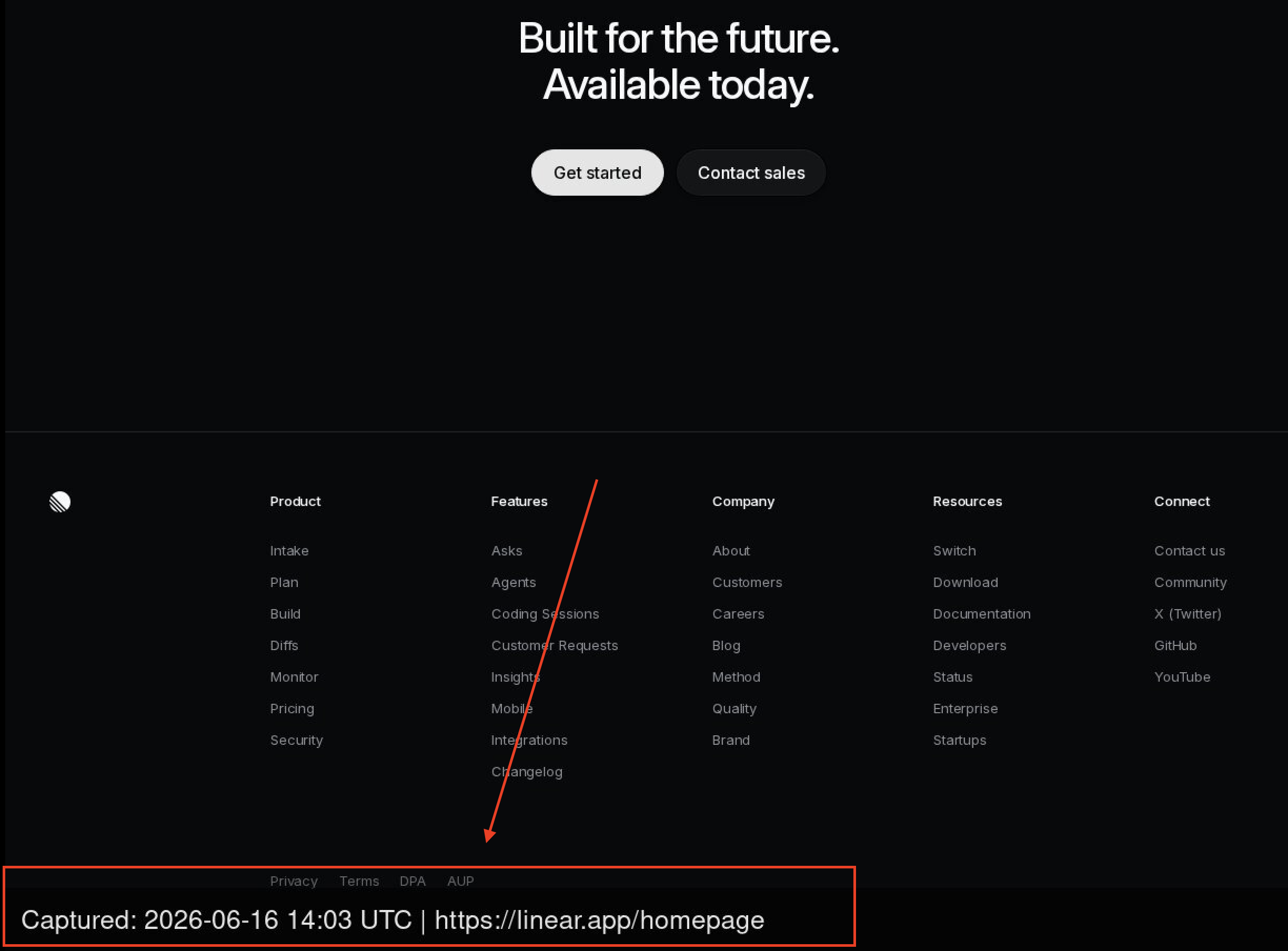
The compliance watermark timestamp stamps each screenshot with the UTC capture time and source URL directly on the image. This matters for compliance because file metadata can be edited. A file's creation date is trivially changeable. A watermark burned into the image pixels cannot be altered without visibly destroying the screenshot. When an examiner asks for proof of what your site showed on a specific date, the watermark answers it immediately.
PDF certificates provide audit-ready evidence
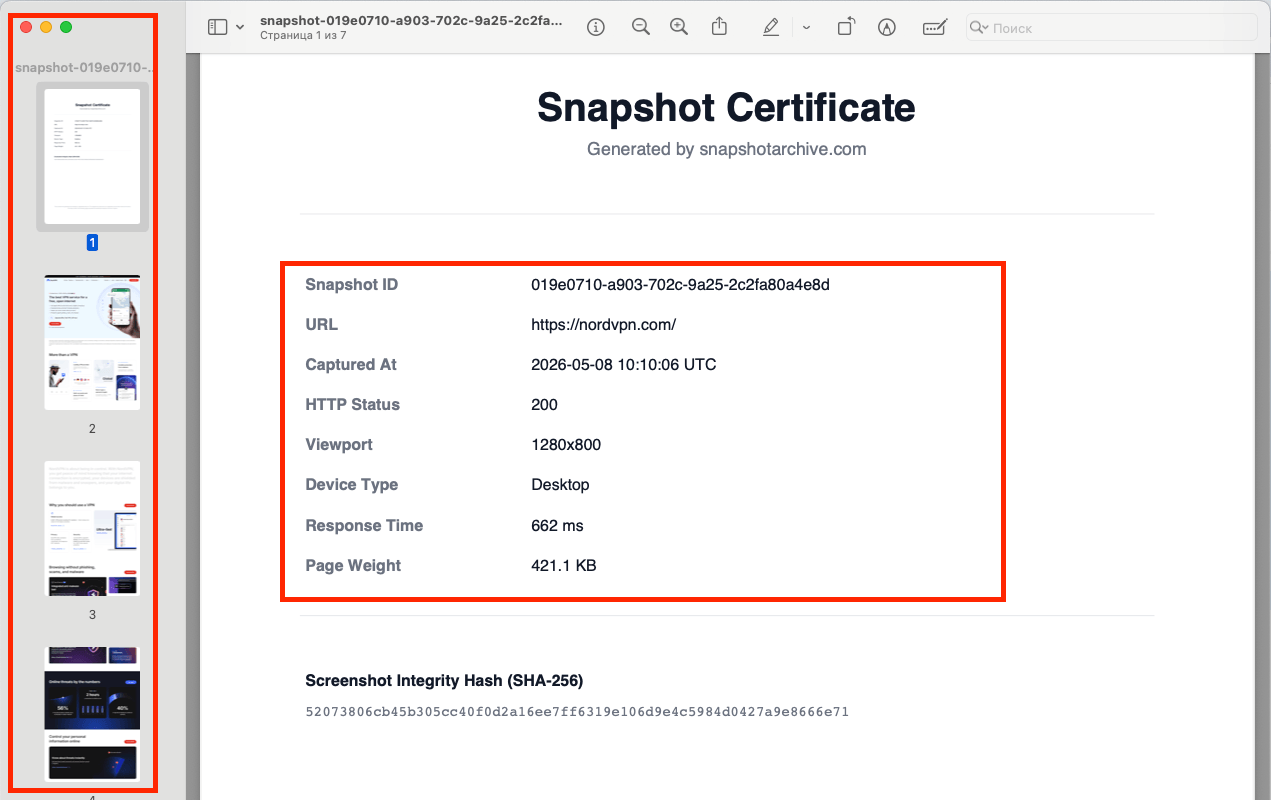
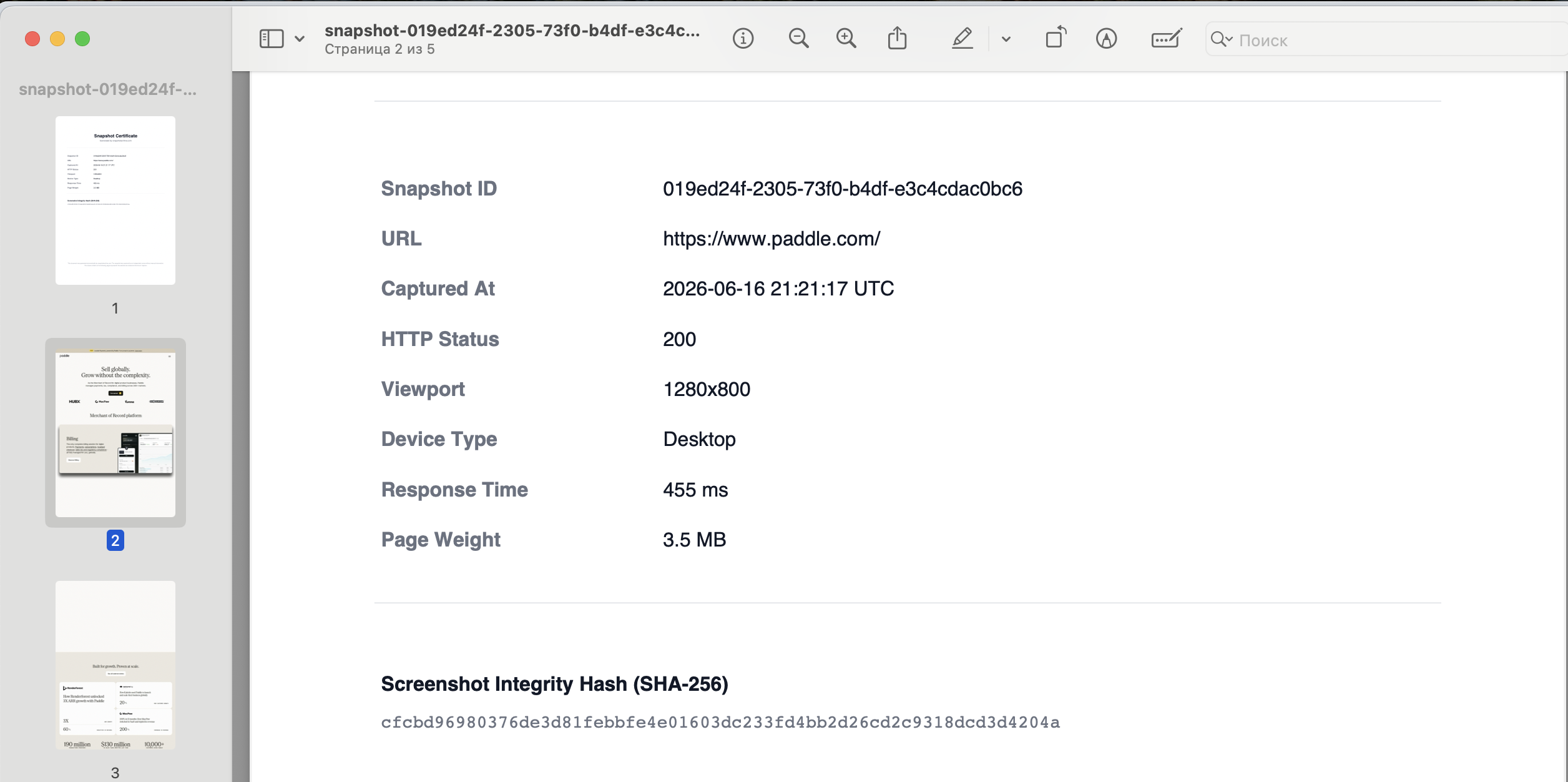
When you need to produce records for a regulatory examination, export the relevant snapshots as PDFs. Each export includes the screenshot plus a Snapshot Certificate page with the capture timestamp, URL, HTTP status code, viewport dimensions, and SHA-256 integrity hash. The hash is what makes this audit-ready: any modification to the PDF produces a different hash, making tampering detectable. This aligns with SEC Rule 17a-4's audit-trail alternative: the hash serves as the integrity verification mechanism that a WORM storage appliance would otherwise provide.
Change detection catches compliance drift
Someone on your team updates a fee schedule without routing it through compliance review. A third-party widget changes the content on your disclosures page. A registered rep edits their bio to include performance claims that haven't been pre-approved. These are the scenarios FINRA Rule 3110 was designed to catch, and change alerts catch them automatically.
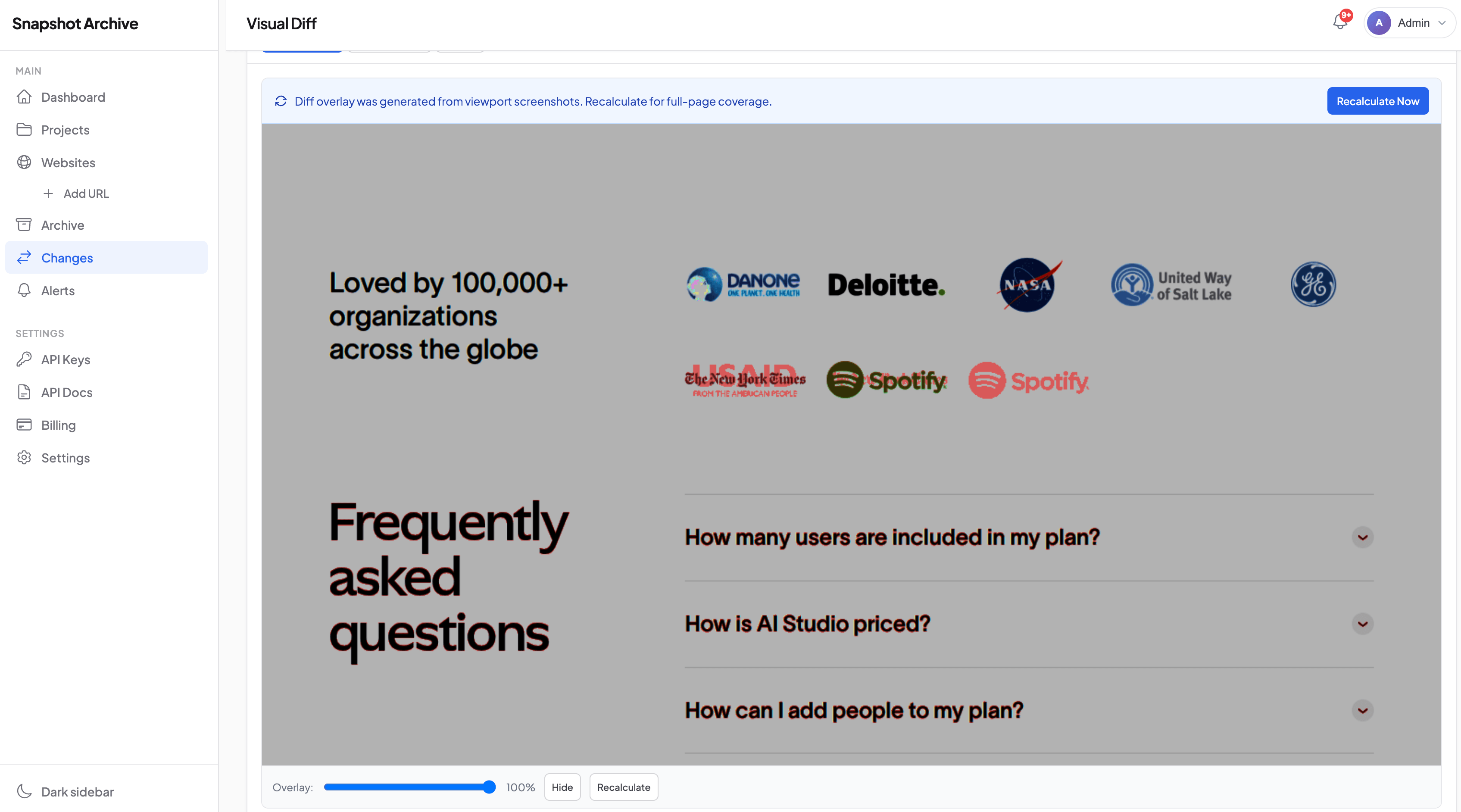
The visual diff shows exactly what changed between consecutive captures. Combined with configurable alert thresholds, your compliance team gets notified when a monitored page changes beyond a set percentage, so routine footer updates don't trigger alerts, but a rewritten fee disclosure does.
What screenshot archiving doesn't replace
Enterprise archiving platforms like PageFreezer and MirrorWeb capture full HTML, CSS, JavaScript, and assets in WARC format for interactive replay. That's the gold standard for full e-discovery. You can reconstruct and interact with the archived page exactly as it appeared. For large broker-dealers with hundreds of pages and active SEC examinations, that level of fidelity may be necessary.
Snapshot Archive captures what a visitor actually saw: a full-page visual record with timestamps, watermarks, and cryptographic verification. It doesn't produce WARC files or interactive replays. It's not a WORM-storage appliance for strict SEC 17a-4 literal compliance, though it aligns with the audit-trail alternative from the 2022 amendments. For firms where the compliance requirement is "prove what your website showed on this date" (and that covers the vast majority of FINRA examinations) this is sufficient at a fraction of the enterprise cost.
Financial advisor website archiving: what a compliance setup looks like
A firm with 15 advisors might monitor 30 to 50 URLs: the main website (10-15 pages), each advisor's bio page (15), key disclosure and ADV pages (5-8), and a few third-party pages where the firm is listed (broker check profiles, custodian pages). All set to daily captures with watermarks enabled.
The compliance officer reviews weekly change alerts. In three months of monitoring, a typical firm flags two or three changes. A fee schedule update that bypassed the review process, and a third-party widget that inserted an unapproved testimonial into an advisor's page. The visual diff shows precisely what changed, and the timestamped captures document when. If a quarterly audit requires documentation, batch-export the relevant date range as PDFs. Each certificate carries its hash for independent verification.
If the firm also tracks vendor terms of service (custodian agreements, technology vendor policies, clearinghouse terms) those go into a separate project for clean organization. The compliance archiving workflow covers the broader setup across multiple page categories. For firms that need to integrate captures into an existing GRC or records management system, the REST API enables programmatic access to snapshots, diffs, and metadata.
Start archiving your financial services website today
Add your firm's disclosure pages and advisor bios first. These are the pages FINRA examiners check most frequently. Enable full-page capture so nothing gets cropped, turn on watermarks, and set it to daily. That setup takes fifteen minutes and starts building your compliance archive immediately.
The free website archiving plan covers three URLs: enough to archive your homepage, a key disclosure page, and one advisor bio. Run it for a month, export a PDF, and show it to your compliance officer. That single certificate, with its timestamp and integrity hash, is usually enough to prove the system works.
Start archiving websites today
Free plan includes 3 websites with daily captures. No credit card required.
Create free account