
Website Archiving for Gambling & iGaming
Nobody archives their gambling website properly. That's not a sales pitch — it's what we keep hearing from operators who call us after their first UKGC compliance review. They had the current version of every page, and nothing else. The examiner wanted last quarter's bonus terms, last year's responsible gambling disclosures, the age gate that was live during a specific complaint period. All gone. Overwritten by the CMS, replaced by the marketing team, never saved anywhere that counts.
Snapshot Archive gives gambling operators automated scheduled captures of their bonus pages, T&Cs, responsible gambling disclosures, and affiliate sites. Every capture carries a UTC watermark and can be exported as a SHA-256 certified PDF for regulatory submissions. For the specific problem of proving what your website showed on a given date, it fills a gap most gambling operators handle with manual screenshots. Or don't handle at all.
TL;DR: Snapshot Archive for Gambling & iGaming
Snapshot Archive automates website archiving for gambling operators. It captures bonus pages, promotional T&Cs, responsible gambling disclosures, age verification gates, and affiliate content on configurable schedules (every 30 minutes to daily). Each capture includes a UTC timestamp watermark and can be exported as a PDF with SHA-256 hash verification. Change detection with visual diff flags when terms or promotions change, and alerts notify compliance teams via email, Slack, Discord, or Telegram. Plans range from Free (3 URLs) to Business ($129/mo, 200 URLs with geo-IP support). Not a replacement for enterprise platforms like MirrorWeb or PageFreezer, but a practical, affordable archiving layer for small-to-mid operators who need audit-ready website records across multiple jurisdictions.
Why gambling regulators care about your website
Regulators don't just review your license application and move on. They come back. Repeatedly. The UKGC's Licence Conditions and Codes of Practice spell out exactly what your website must display and how it must behave. Code 5.1.1 governs bonus and reward rules, and starting January 2026, it caps wagering requirements at 10x and bans mixed-product bonus offers. Code 5.1.6 covers advertising compliance. Code 1.1.2 makes operators directly accountable for what their affiliates publish. Break any of these, and the Commission doesn't need to prove intent. The violation itself is enough.
Malta's approach is different but no less demanding. The MGA issued 30 penalties totaling €162,520 in 2025. Sounds almost cheap compared to UK fines. Don't let that fool you. MGA enforcement escalates fast. License suspension or revocation follows repeat offenses, and the MGA has shown a willingness to act quickly when licensees fail to maintain accurate website disclosures.
In the US, it's a patchwork. New Jersey's Division of Gaming Enforcement requires the 1-800-GAMBLER hotline in all advertising, prohibits claims of "guaranteed wins" or "risk-free" bets, and mandates clear wagering requirement disclosures. Every state with legalized sports betting has its own variation. Pennsylvania differs from Michigan differs from Colorado. Operate in multiple US states? Your website content has to satisfy all of them. Miss one and that's the state that finds you.
The UK's Advertising Standards Authority adds another layer. In September 2025, the ASA rolled out updated gambling advertising rules. In June 2026, they began enforcing social media gambling ad requirements. Before that, in June 2025, the ASA initially ruled that a Ladbrokes "Ladbucks" promotion appealed to children, though the decision was overturned on review in April 2026. The episode still shows how quickly advertising content attracts regulatory attention. These rulings reference specific website content and specific dates. Without an archive, you can't prove your page was compliant before the ruling came down.
So you've got a documentation problem. Your website changes constantly. New promotions launch, bonus terms update, responsible gambling pages get revised. Without automated compliance archiving, you're relying on your CMS version history (which most platforms purge) or manual screenshots (which carry no verifiable timestamp). Neither holds up under regulatory scrutiny. We've talked to operators who lost arguments with regulators over bonus T&C changes they knew they'd made correctly but couldn't prove the timing.
Recent gambling compliance enforcement actions
Fines are getting bigger. Investigations move faster than they did even two years ago. A few recent cases tell the story:
| Operator | Fine | Year | Reason |
|---|---|---|---|
| William Hill / Mr Green / 888 | £19,200,000 | 2023 | AML and social responsibility failures |
| Entain | £17,000,000 | 2022 | AML and social responsibility failures |
| Platinum Gaming (Unibet) | £10,000,000 | 2025 | Failed to identify player who lost £5K in 24 hours, £16K in 3 months |
| Spreadex | £2,022,000 | 2025 | AML and social responsibility failings |
| ProgressPlay | £1,000,000 | 2025 | AML, social responsibility failures; affiliate video content cited |
| Done Brothers (Betfred) | £825,000 | 2025 | Compliance failings |
| bet365 | £582,120 | 2024 | AML and social responsibility failures |
Spot the pattern? Almost every penalty includes "social responsibility failures," which in practice means the operator's website didn't adequately display responsible gambling tools, self-exclusion options, or deposit limit information. Or it displayed them but changed them, and the operator couldn't demonstrate what was shown and when.
Starting October 2025, the UKGC's new penalty framework sets fines at 10-15% of gross gambling yield for serious breaches, with the potential to exceed that in exceptional cases. For a mid-size operator doing £50M GGY, that's a potential £7.5M fine. The cost of archiving your website content is a rounding error by comparison.
What pages gambling operators should archive
Not everything on a gambling site carries equal regulatory weight. Compliance teams should be archiving these pages, roughly in order of how much trouble they cause:
Bonus and promotional T&Cs. Every welcome offer, reload bonus, free spin promotion, and loyalty reward comes with terms. Wagering requirements, game weighting, time limits, maximum bet rules, withdrawal caps. These terms change frequently, sometimes daily for limited promotions. When a player disputes a bonus, the regulator asks what terms were displayed when the player opted in. You need the answer. This includes responsible gambling messaging within promotions. Every promotional page should carry it. Does it? Always? Archive it and you'll know.
Responsible gambling pages. Your GAMSTOP integration disclosure, self-exclusion options (6-month, 1-year, 5-year), deposit limit tools, reality check settings, and links to support organizations like GamCare and BeGambleAware. The UKGC checks these. Regularly.
Age verification and identity gates. The landing experience for new visitors. What age gate do they see? What KYC disclosures appear? What happens before they can access gambling content? Screenshots of these flows document your first line of defense. For operators also concerned about legal evidence standards, timestamped age gate captures carry real weight.
Odds and market pages. Particularly for sportsbooks, the odds displayed at a specific time can become evidence in disputes. A full-page capture with a UTC watermark proves what odds were offered and when.
Affiliate landing pages. This is the one most operators underestimate. More on this below.
Privacy policy and cookie consent. GDPR applies to gambling sites the same as any other. Track changes to your own policies and monitor third-party policy pages that affect your operations. Our terms and privacy tracking use case covers this in detail.
How Snapshot Archive works for gambling operators
Set up monitoring in minutes
Add the URLs you need to track. A typical mid-size operator monitors 30-80 pages: the main site's bonus pages, T&Cs sections, responsible gambling area, plus affiliate sites and competitor promotions. Set your capture frequency. Daily for stable pages like T&Cs. Every 6 or 12 hours for active promotions. Hourly during campaign launches. The system runs scheduled captures automatically. No browser extensions, no manual triggers, no one has to remember.
Every capture carries a timestamp you can trust
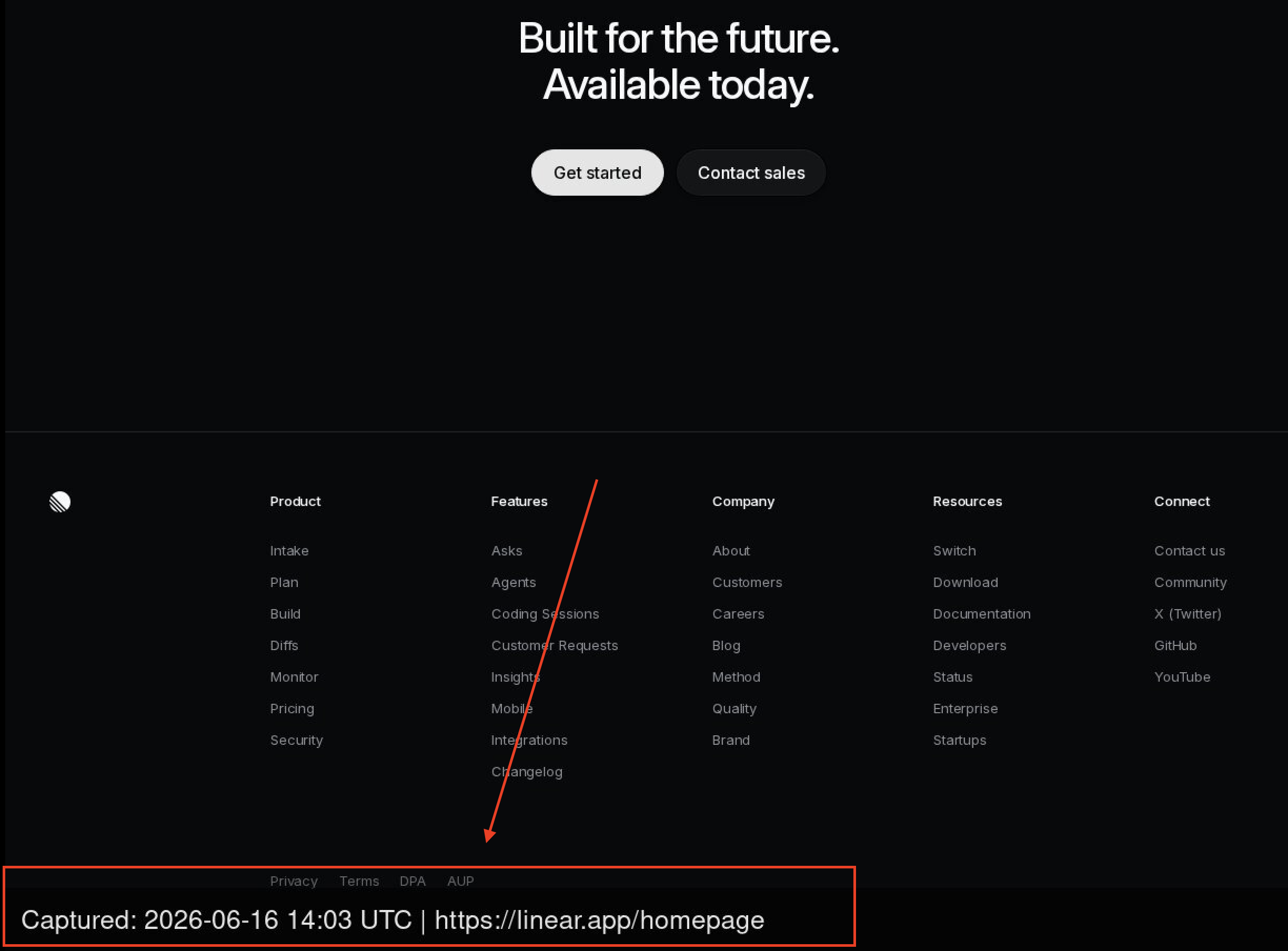
Each screenshot includes a watermark showing the exact UTC date and time of capture, plus the URL. This isn't metadata that could be edited. It's burned into the image itself. When a regulator asks "what did your bonus page show on March 15th at 2 PM?", you pull the capture. The timestamp is right there. No ambiguity about time zones, no reliance on file system dates that anyone could modify.
Export audit-ready PDFs with cryptographic verification
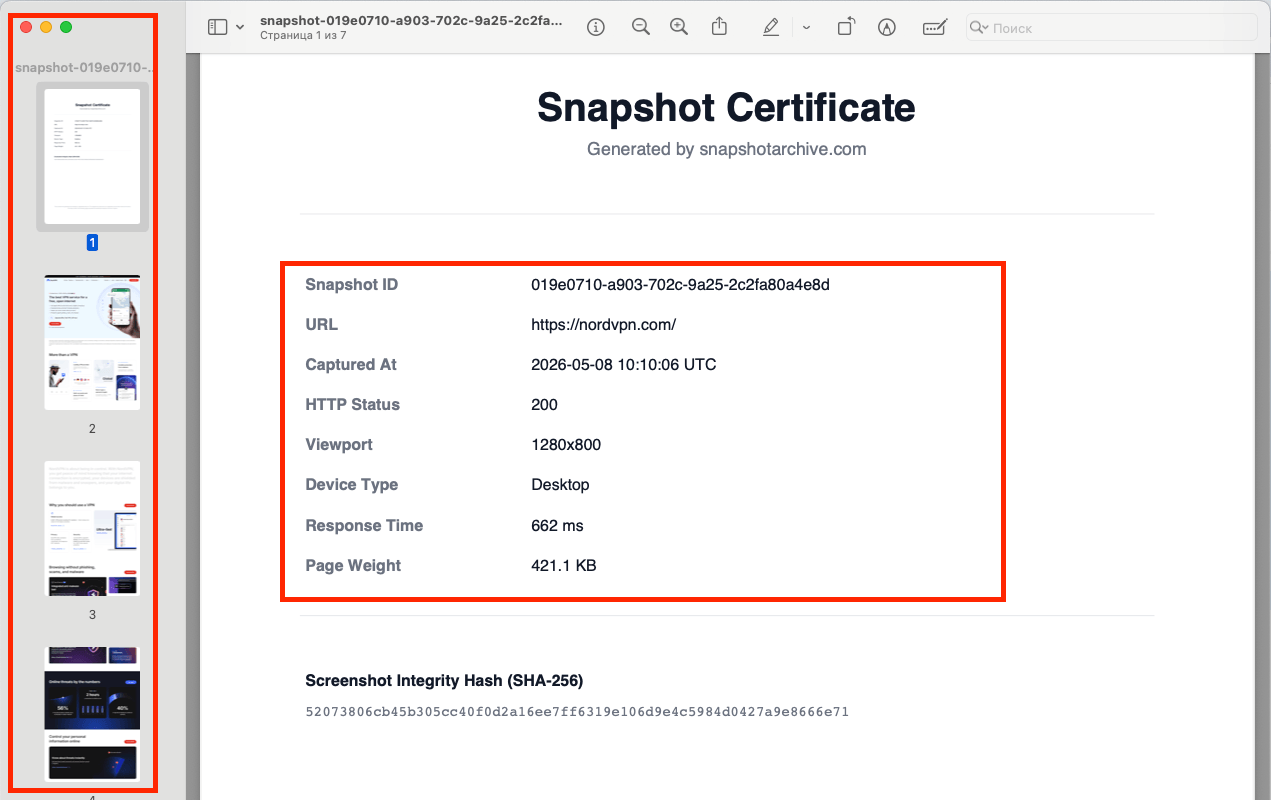
Regulators and legal teams want documents, not dashboard access. The PDF export produces a certificate that includes the SHA-256 integrity hash, the captured URL, HTTP response code, viewport dimensions, response time, and page weight. The hash proves the capture hasn't been tampered with after the fact. Hand this to your compliance officer, your legal counsel, or the regulator directly.
Catch changes before regulators do
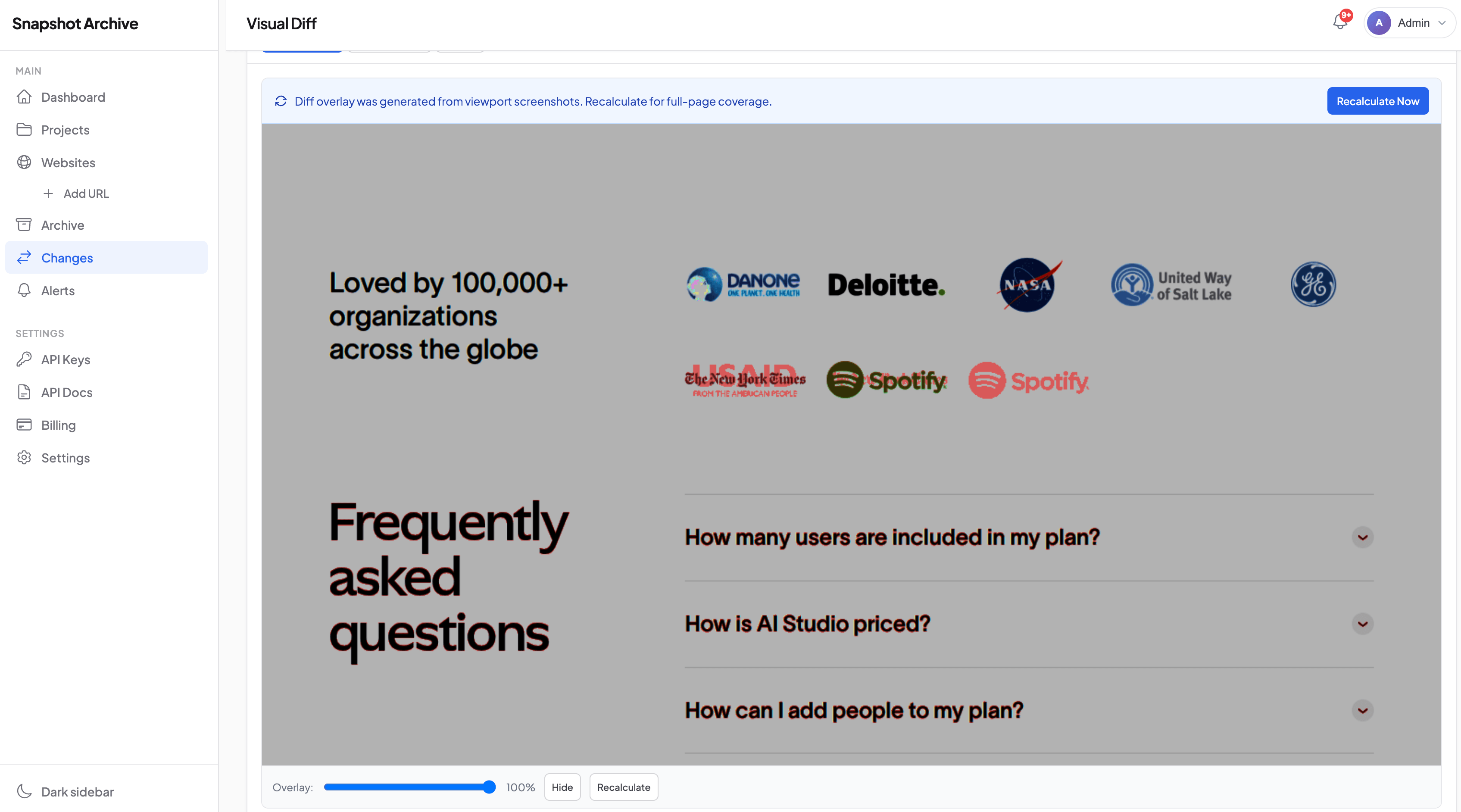
When someone on your team updates bonus terms, or when an affiliate changes a landing page without telling you, change detection flags it. The visual diff shows exactly what changed between two captures using overlay, side-by-side, or slider views. Alert notifications go out via email, Slack, Discord, or Telegram. Your compliance team sees the change within hours, not after a regulator's letter arrives.
The gambling affiliate compliance problem
This deserves its own section because it's where operators keep getting burned.
LCCP Code 1.1.2 makes gambling operators directly accountable for the conduct of their affiliates. Not "somewhat responsible." Directly accountable. If an affiliate publishes misleading bonus claims, exaggerated win rates, or content that appeals to minors, the operator faces the enforcement action. The affiliate might lose their partnership. The operator loses money and, potentially, their license.
ProgressPlay learned this the hard way. In 2025, the UKGC fined them £1,000,000 because affiliate-produced video content violated advertising standards. ProgressPlay didn't create the content. Their affiliates did. Didn't matter. The fine landed on ProgressPlay.
Most operators manage affiliates through contractual terms and periodic manual reviews. Quarterly audits, maybe. Someone on the compliance team visits affiliate sites, scrolls through, makes notes. It's slow, incomplete, and it misses changes between reviews. An affiliate could publish a non-compliant promotion on a Tuesday, take it down on a Thursday, and by the time the quarterly review happens, there's no trace it ever existed.
Automated archiving changes that equation. Set up daily or twice-daily captures of your top affiliate landing pages. When content changes, change detection flags it and your team gets notified. You catch the Tuesday violation on Tuesday, not three months later. And if you need to prove to the UKGC that you actively monitor affiliate compliance, you have a date-stamped archive of every version of every affiliate page you track.
Fair warning: you'll need to decide which affiliates to monitor. Most operators work with dozens or hundreds of affiliates. You can't archive them all on a Starter plan. Prioritize by traffic volume, complaint history, and regulatory risk. The top 20-50 affiliate pages cover the bulk of your exposure.
Multi-jurisdiction gambling website archiving
If you hold licenses in multiple jurisdictions (UKGC, MGA, a couple of US state licenses), your compliance obligations stack. Different retention periods. Different advertising rules. Different responsible gambling requirements. A promotion that's perfectly compliant in Malta might violate New Jersey's ban on "risk-free" language.
Record retention requirements vary significantly:
| Jurisdiction | Retention requirement | Notes |
|---|---|---|
| UK (UKGC) | Minimum 3 years after license expires | Many operators retain 5+ years as a buffer |
| Malta (MGA) | 5 years after business relationship ends | Includes promotional materials and website content |
| New Jersey (DGE) | 5 years | Applies to all advertising and promotional records |
| Gibraltar | 5 years | May extend for AML-related records |
| Isle of Man (GSC) | 6 years | Longer than most jurisdictions |
| Alderney (AGCC) | 10 years for financial records | Website content retention follows general record-keeping rules |
These periods matter when choosing an archiving plan. Our Free tier retains captures for 30 days. That's useful for testing but worthless for compliance. The Pro plan ($39/month) keeps captures for 1 year. The Growth plan ($79/month) retains for 2 years. The Business plan ($129/month) holds captures for 3 years. For operators with 5-year retention obligations, you'll need to export and store PDF certificates in your own document management system for the remaining period. We're upfront about that. Our longest retention is 3 years, and some jurisdictions demand more. Check our retention guide for strategies on managing longer requirements.
For operators serving different content by geography (showing UK-specific T&Cs to UK visitors, for example), our Business plan includes geo-IP capture by request. This lets you archive what visitors in specific countries actually see, rather than what your site serves to a generic US-based bot. That matters when UK and Maltese regulators are checking compliance with their specific requirements and your site shows different content to each audience. Operators already using competitor monitoring for tracking rival promotions will find geo-IP captures especially useful for seeing what competitors show in different markets.
Honest comparison: what we don't do
Disclosure: we sell Snapshot Archive, so take this section with appropriate skepticism. That said, we'd rather you pick the right tool than buy ours and be disappointed.
Enterprise archiving platforms exist for the gambling industry. MirrorWeb, PageFreezer, and Hanzo offer WARC-format capture, full replay of archived pages (clicking links, scrolling, interacting), social media archiving, and integrations with GRC platforms. They typically cost $500 to $5,000+ per month, require implementation projects, and target operators with dedicated compliance teams and six-figure compliance budgets.
Insightful Technology specifically targets the betting sector, but their focus is transaction monitoring, not website archiving.
Snapshot Archive is a screenshot archiving tool. What we don't do:
- No WARC replay. We capture images of pages, not interactive copies.
- No social media archiving. Web pages only.
- No user action simulation. We can't log in, place bets, or click through deposit flows.
- No keyword or text monitoring. We detect visual changes, not specific text strings.
- No built-in GRC integration. Captures export as PDFs or are accessible via API, but there's no native connector to compliance platforms.
- No Chrome extension for on-demand manual captures.
Where we fit: small-to-mid gambling operators (under 200 monitored URLs) who need affordable, automated website archiving with verifiable timestamps and don't need enterprise-grade replay or social media capture. The global RegTech market exceeded $14B in 2025 and is projected to reach $21.8B by 2026. Most of that money flows to enterprise solutions. We exist for the operators who sit below that threshold, the ones currently doing nothing or doing it manually. If you need the full enterprise suite, look at MirrorWeb or PageFreezer. If you need visual archiving that actually runs every day without someone remembering to open a browser and press Print Screen, we're a strong fit. Our comparison of manual vs. automated screenshots breaks down the trade-offs in more detail. And if you're evaluating alternatives, our pages on Stillio and Visualping explain how we compare to those tools specifically.
Which plan fits gambling operators?
| Scenario | Recommended plan | Why |
|---|---|---|
| Testing the tool on 2-3 key pages | Free (3 URLs, daily) | No commitment. Archive your main bonus page, T&Cs, and responsible gambling page. See what you've been missing. |
| Single-brand operator, one jurisdiction | Starter, $14/mo (20 URLs, every 12h, 90 days) | Covers your core site pages. Good for operators just starting to formalize website compliance. |
| Multi-brand or affiliate monitoring | Pro, $39/mo (50 URLs, every 6h, 1 year) | Enough capacity for your own sites plus top affiliate pages. API access for automation. 1-year retention. |
| Multi-jurisdiction with 50-100 pages | Growth, $79/mo (100 URLs, every 1h, 2 years) | Hourly captures during promotions. 2-year retention covers most jurisdictions' minimums. |
| Large operator or group with geo-targeting | Business, $129/mo (200 URLs, every 30min, 3 years) | Geo-IP capture for jurisdiction-specific content. 3-year retention. High-frequency captures for live promotions. |
Most gambling operators we've spoken with land on Pro or Growth. The deciding factors are usually affiliate monitoring needs (more pages) and retention requirements (longer storage). If you hold a UKGC license and take compliance seriously, the Starter plan's 90-day retention is too short for any real regulatory purpose.
Why gambling compliance archiving matters right now
When the UKGC's wagering requirement cap (10x maximum, no mixed-product bonuses) took effect in January 2026, every UK-licensed operator had to update their bonus terms simultaneously. For compliance teams, the question wasn't whether their own site was updated. They knew it was. They did it themselves. The question was whether they could prove what the old terms said, when the transition happened, and that no version of the site displayed non-compliant terms after the deadline.
Without an archive, that proof doesn't exist. The old page is gone. CMS version history might show a draft, but not what the live site actually rendered. A screenshot from December 2025 might exist on someone's laptop, but it carries no timestamp verification and no integrity hash. It's just a JPEG. We've written about why screenshots need proper authentication to hold up in regulatory and legal contexts.
That kind of regulatory transition will keep happening. Over 60% of gambling jurisdictions updated their regulations by the end of 2025. EU member states saw a 15% increase in compliance costs compared to 2023. The pace isn't slowing down. Mobile gambling now accounts for the majority of online gambling revenue, over 65% globally and higher in markets like the US. Regulators are increasingly focused on mobile-specific compliance: how responsible gambling messages render on small screens, whether age gates work on mobile browsers, whether bonus terms are legible on a phone. Full-page captures across different viewports document all of this.
Archiving your gambling site isn't a nice-to-have anymore. With UK Q4 2025 gross gambling yield at £4.5B and remote GGY for full-year 2025 reaching £5.55B, regulators have both the funding and the motivation to enforce harder. The question for operators is straightforward: can you produce a timestamped, tamper-evident record of what your website showed on any given date? If the answer is no, that gap will cost you far more to address after the fact than any archiving tool on the market.
Frequently Asked Questions
The UKGC requires operators to retain copies of all advertising and promotional materials under LCCP conditions. The MGA requires retention of promotional materials and website content for 5 years after the business relationship ends. US state gaming commissions (NJ DGE, PA PGCB, MI MGCB) each have their own advertising record-keeping requirements. Snapshot Archive automates this by capturing timestamped screenshots of your gambling website on a schedule you set.
Daily captures are the minimum for most compliance needs. Promotional pages and bonus terms should be captured every 6-12 hours since they change frequently. During campaign launches or regulatory transition periods (like the January 2026 UKGC wagering cap change), hourly captures provide better coverage. Static pages like responsible gambling disclosures can be archived daily.
Yes. Snapshot Archive screenshots include UTC timestamp watermarks burned directly into the image and can be exported as PDF certificates with SHA-256 cryptographic hashes. The hash proves the document has not been altered since capture. This combination of visual timestamp and cryptographic verification provides verifiable evidence for UKGC Section 116 requests, MGA compliance reviews, and US state gaming commission audits.
Priority pages include: bonus and promotional terms and conditions, responsible gambling pages (GAMSTOP disclosure, self-exclusion options, deposit limits), age verification gates, odds and market display pages, affiliate landing pages that promote your brand, and privacy and cookie consent pages. Bonus T&Cs and promotional pages carry the highest regulatory risk because they change most frequently.
Schedule automated captures of your responsible gambling pages, self-exclusion tools, deposit limit interfaces, GAMSTOP integration disclosures, and warning messages. Each capture gets a UTC timestamp watermark proving the content was live on that date. Export PDF certificates with SHA-256 hashes when needed for regulatory submissions. This creates a continuous, verifiable record that responsible gambling content was displayed throughout the compliance period.
UKGC LCCP requires licensees to retain copies of all advertising and promotional materials. Records must be kept for a minimum of 3 years after the license expires, though many operators retain for 5+ years as a buffer. LCCP Code 5.1.1, updated January 2026, also requires that bonus wagering requirements do not exceed 10x and bans mixed-product promotional offers. Automated archiving ensures every version of your promotional content is captured and retained.
License renewals often require demonstrating ongoing compliance throughout the license period, not just at the time of application. A continuous archive of your website proves that responsible gambling content, required disclosures, and compliant advertising were displayed consistently. Without an archive, you can only show what your site displays today, not what it showed over the past years.
Yes. Snapshot Archive captures any publicly accessible URL regardless of language or location. For operators with multi-jurisdiction presence, each market-specific site version can be archived independently. The Business plan ($129/month) includes geo-IP capture by request, which archives what visitors in specific countries actually see, important when your site serves different content to UK, Malta, and US visitors.