
Website Archiving for Insurance Companies
Insurance regulators don't negotiate timelines. They show up with document requests, and you either have the records or you don't. Website content sits in a strange blind spot for most carriers and agencies. It counts as advertising under every state DOI's rules, but almost nobody archives it properly.
That gap has gotten expensive. The FTC proposed a $100 million order against Assurance IQ in 2025 for deceptive marketing of health insurance plans through its website and call center operations. MediaAlpha agreed to a $45 million FTC settlement in 2025 over allegedly misleading lead generation practices. These weren't obscure violations buried in policy filings. They were things on websites that changed, disappeared, or couldn't be reproduced when regulators came looking. For a broader look at compliance archiving across industries, see our compliance archiving guide.
Why website content is advertising (and why that matters)
Any web page a consumer sees before buying a policy counts as advertising under NAIC Model Regulation 570. That includes landing pages, online quoting tools, chatbot scripts, agent bio pages, and everything in between. More than thirty states have enacted some version of Model 570, and the rest have their own advertising statutes that reach the same conclusion. States also use SERFF (the System for Electronic Rates and Forms Filing) to track filed ad materials, which means your promotional pages need to match what's on record.
This is where the gap opens. A printed brochure sits in a filing cabinet. A web page doesn't. It changes on Tuesday, changes again on Thursday, and by the time a DOI examiner asks about the version from six months ago, nobody can produce it. The content management system overwrites itself. The marketing team pushed an update. The developer deployed a new template. Gone.
Under Model 570, marketing content must be retained for at least four years from the date of last use. But state variations push that higher. New York requires six years. Pennsylvania demands seven. Washington state wants five. California has a three-year minimum for long-term care promotional pages specifically, with longer windows for other lines. And "date of last use" means the last day that page was live, not the day someone created it.
Running an insurance operation across multiple states means you're juggling the strictest retention window that applies. For most carriers, that's effectively seven years of website history you should be able to reproduce on demand.
The fines are real and getting bigger
A quick look at recent enforcement actions tells you where regulators are focused.
| Company | Year | Fine | Issue |
|---|---|---|---|
| Assurance IQ | 2025 | $100,000,000 | Deceptive health plan marketing via website |
| MediaAlpha | 2025 | $45,000,000 | Misleading insurance lead generation websites |
| United Benefits | 2025 | $250,000 | Unauthorized insurance sold through online marketing |
| GEICO | 2015 | $6,000,000 | Online quoting system misrepresentation (CA DOI) |
| Various (WA OIC) | Q3 2024 | $302,500 | Advertising violations, one quarter alone |
Washington's Office of the Insurance Commissioner issued $302,500 in advertising-related fines in a single quarter of 2024. That's routine enforcement, not headline-grabbing action. The steady drumbeat of smaller penalties hits agencies and mid-size carriers who assumed nobody was watching their websites.
Without archived copies of what your site actually showed on a specific date, defending against these claims becomes a guessing game. You're left telling regulators "we think that page said X" instead of showing them a timestamped screenshot that proves it.
What a DOI market conduct exam actually looks for
Market conduct examinations are where it gets real. Examiners review how an insurer interacts with policyholders and the public, and advertising compliance is always on the checklist. NAIC's Market Regulation Handbook includes specific protocols for reviewing ad materials, and "materials" includes everything on your website.
During an exam, you might be asked to produce:
- Historical versions of product landing pages for a specific date range
- Rate quote page content as it appeared in a particular state and time period
- Agent or broker bio pages showing licensing disclosures
- Terms, conditions, and disclaimers presented to consumers before purchase
- Marketing claims about coverage benefits, exclusions, or pricing
- Evidence that website content matched filed advertising materials
Most carriers we've spoken with can produce the current version of these pages. That's it. Ask them for last quarter's version and they start digging through Wayback Machine results, which examiners don't accept as official records because you don't control that archive and can't verify completeness.
The agent oversight problem
Carriers aren't just responsible for their own websites. Under NAIC Model 880 (the Unfair Trade Practices Act, enacted in all but five states), carriers bear responsibility for the advertising activities of their appointed agents and brokers. If an appointed producer's website makes misleading claims about your products, that's your problem too.
Over 2 million licensed producers operate in the US. No carrier can manually review every agent's website on a regular basis. But regulators don't care about the difficulty. They care about compliance. A change detection system that monitors agent websites and flags modifications gives you at least a fighting chance of catching problems before an examiner does.
How Snapshot Archive works for insurance archiving
Snapshot Archive captures timestamped, hash-verified screenshots of web pages on a schedule you control. We built it to solve exactly this kind of problem: regulated industries that need proof of what a web page showed on a given date. The setup for insurance companies is straightforward, and our process page walks through the full workflow.
Set up your monitoring URLs
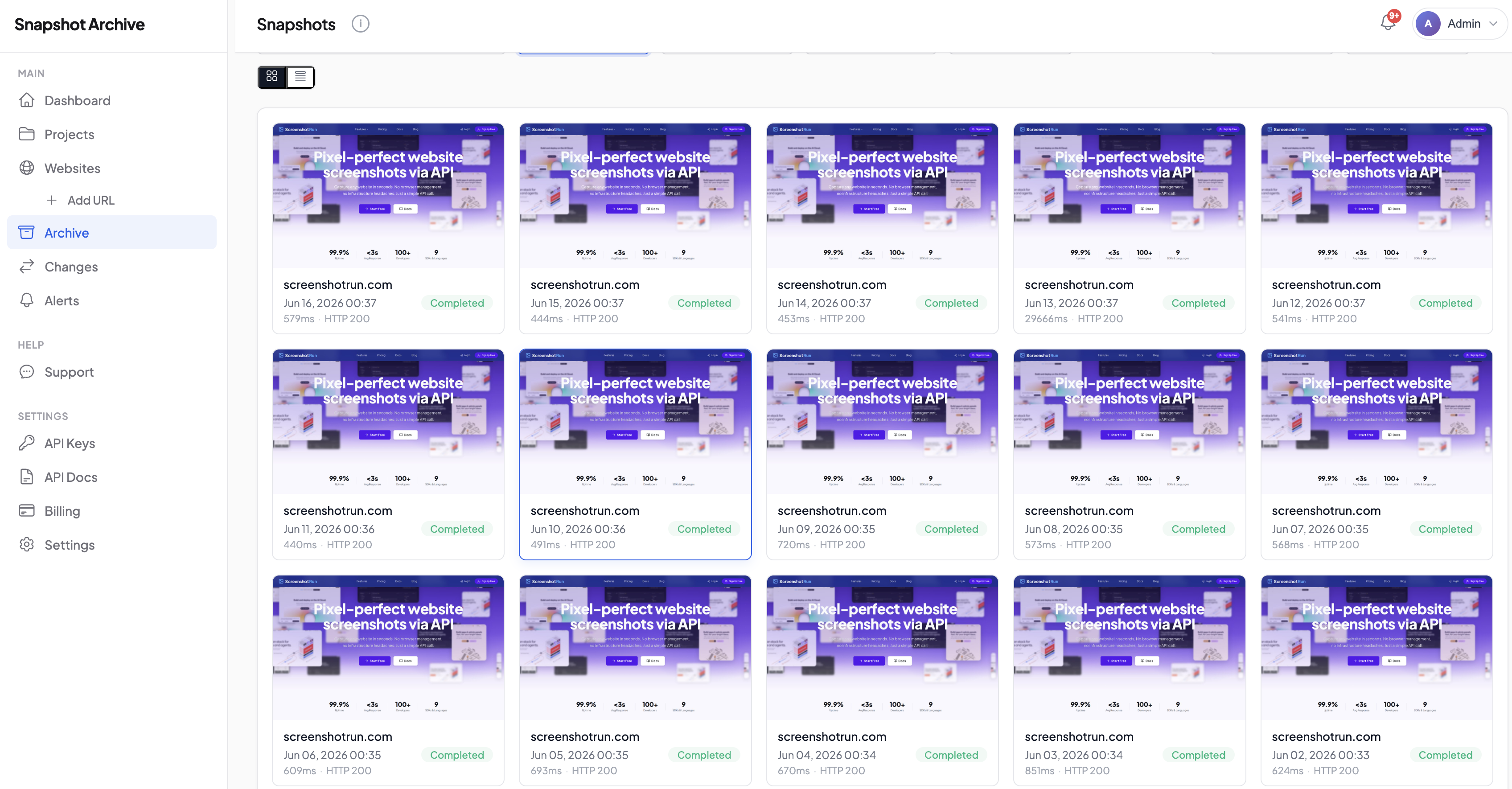
Add the URLs you need to archive. For a typical insurance carrier or agency, that's your product pages, quoting tools, agent directory, terms and conditions, marketing landing pages, and a few others. Each URL gets captured on whatever schedule you set. Daily for most compliance needs, more frequently if pages change often.
Full-page screenshots capture everything from header to footer, including dynamic content that loads below the fold. Rate calculators, comparison tables, disclosure text at the bottom of the page. All of it shows up in the capture.
Every capture gets a timestamp
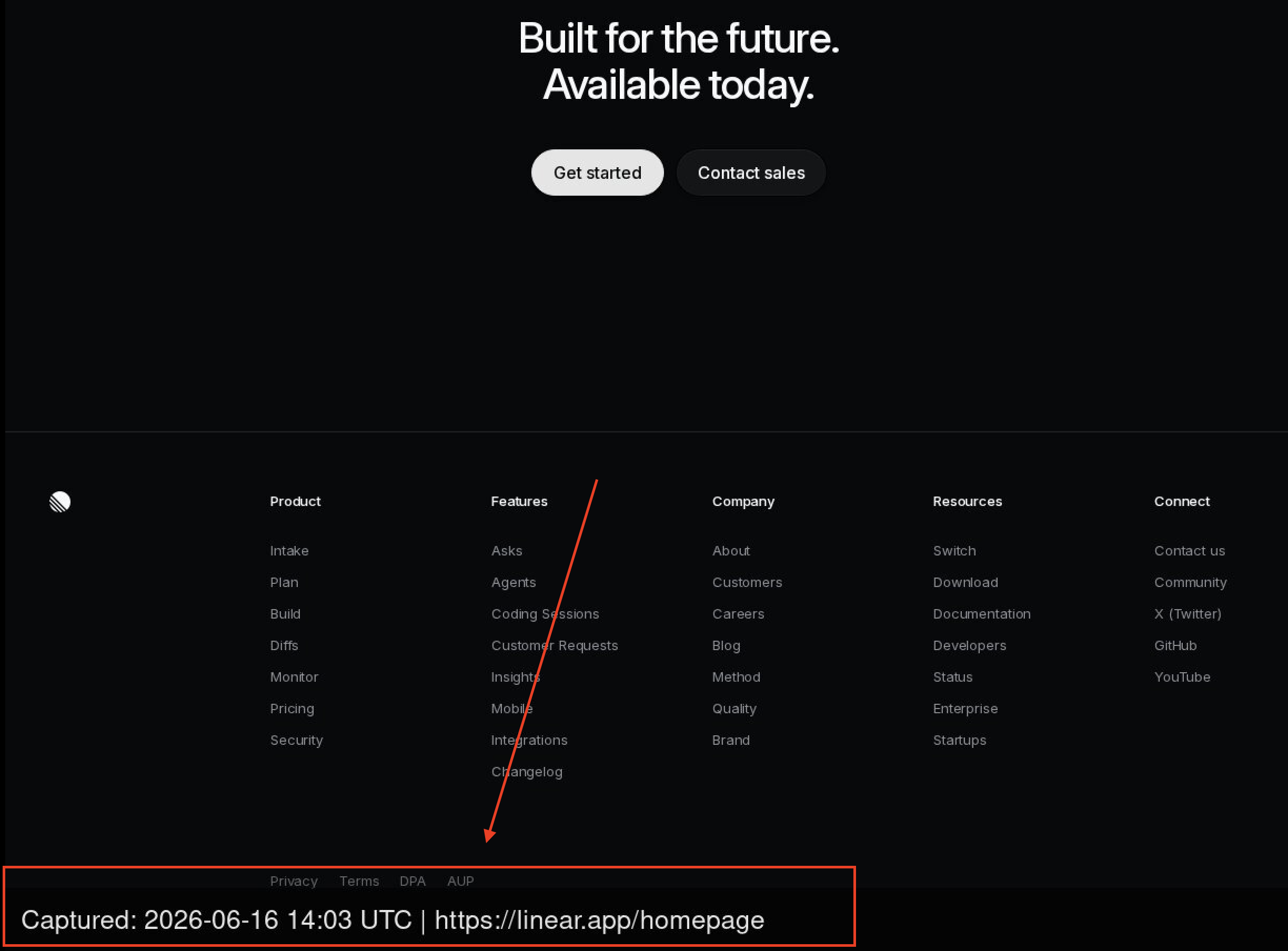
Each screenshot includes a UTC timestamp watermark burned directly into the image. This isn't metadata that can be edited. It's part of the visual record. When an examiner asks what your quote page showed on March 15th, you pull up that day's capture and the timestamp is right there.
Export court-ready documentation
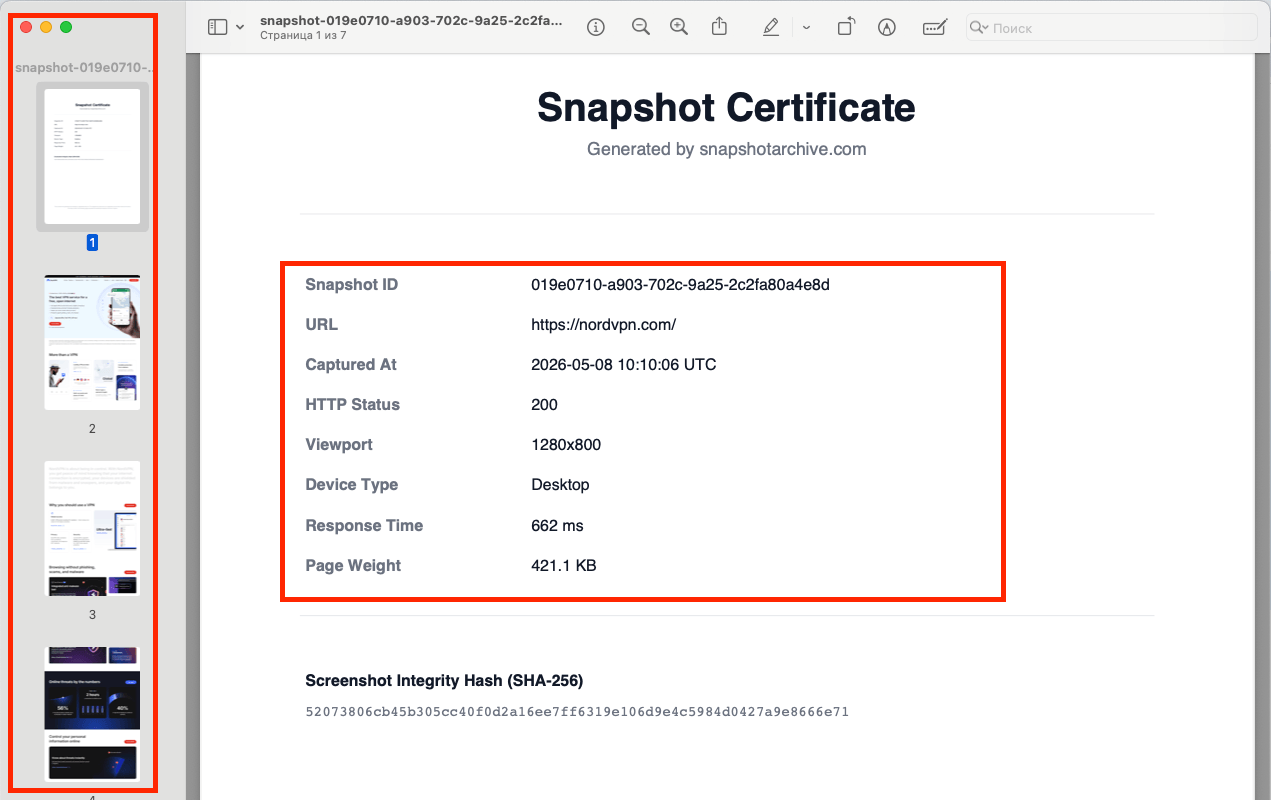
For DOI examinations or E&O claims, you can export any capture as a PDF certificate that includes a SHA-256 cryptographic hash. The hash proves the document hasn't been altered since capture. Pair that with the UTC timestamp and you've got documentation that satisfies the kind of evidentiary standards law firms and regulators expect.
Catch changes before they become problems
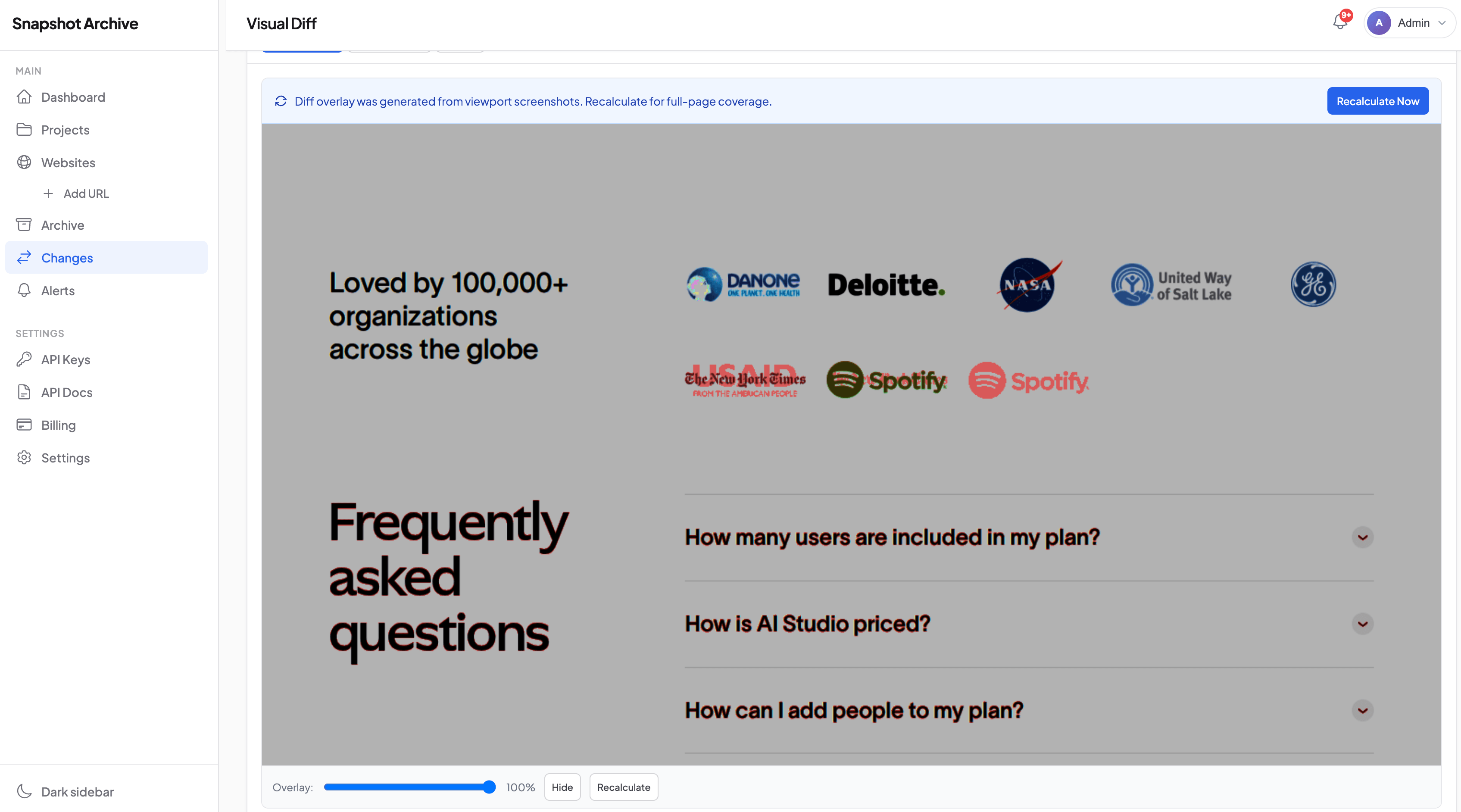
The visual diff tool overlays two captures and highlights every pixel that changed. You can compare yesterday's version of a page to today's, or jump back six months. The threshold is tunable. Ignore minor rendering differences and focus on actual content changes.
Set up change alerts and get notified through email, Slack, Discord, or Telegram whenever a monitored page changes beyond your threshold. For carrier compliance teams watching appointed agent websites, this is the difference between finding problems proactively and learning about them during an examination.
Five scenarios where this pays for itself
1. Rate quote pages that vary by state, ZIP, and age
Insurance quoting pages are dynamic. The same URL shows different rates depending on location, age, coverage selection, and a dozen other variables. When a consumer files a complaint saying "the website showed me rate X but I was charged rate Y," you need proof of what that page displayed.
With scheduled screenshots running daily or every 12 hours, you build a continuous record of your quoting interface. Won't capture every possible input combination, and we're upfront about that limitation, but it documents the default presentation, disclaimers, and any rate changes that rolled out on specific dates.
2. Annual Certificate of Compliance
Many states require insurers to file an annual certificate confirming that all marketing content complies with state regulations. Having a complete archive of every version of your website throughout the year makes this certification defensible rather than aspirational. You can actually review what was published, when it changed, and whether each version met requirements.
3. Carrier audits of agent websites
Suppose you're a regional carrier with 400 appointed agents. Each one has a website. Some mention your products by name. Others make claims about coverage that may or may not match your filed materials. Checking all 400 manually every quarter? Not realistic.
On our Growth plan, you can monitor up to 100 URLs with hourly captures. Pick your highest-risk agents (the ones with the most web traffic or the most consumer complaints) and let the change detection system flag when their sites change. It's not total coverage, but it's a documented good-faith effort at oversight, which is what examiners want to see.
(There are more scenarios, but these come up constantly.)
4. Defending against E&O claims
Errors and omissions claims often hinge on what information was or wasn't presented to the consumer. "Your website said my flood damage would be covered" is hard to refute without archived evidence of what the website actually said on the date in question. Screenshots with timestamps and cryptographic hashes serve as legal evidence that's far stronger than someone's recollection.
5. Competitor intelligence (yes, compliance teams do this too)
A mid-size P&C carrier we worked with had their compliance team archiving competitor websites not just for competitive intelligence but to identify industry trends in advertising language that regulators might start scrutinizing. When one major carrier's marketing claim drew a DOI inquiry, they could quickly check whether their own site used similar language. That alone justified the cost of monitoring.
Retention periods by state: a partial reference
The most common question we hear: how long do you need to keep screenshots? For insurance advertising, it depends on where you operate.
| State | Minimum retention | Basis |
|---|---|---|
| NAIC Model 570 (baseline) | 4 years | From date of last use |
| New York | 6 years | NY Insurance Law §2123 |
| Pennsylvania | 7 years | 31 Pa. Code Chapter 51 |
| Washington | 5 years | WAC 284-17 |
| California (LTC ads) | 3 years | CCR Title 10 §2266 |
| Texas | 5 years | 28 TAC §21.120 |
| Florida | 5 years | F.S. §626.9541 |
This table covers the states we get asked about most. Not exhaustive. Check your state DOI's specific requirements. Operating in multiple states? Retain for the longest applicable period. Our Pro plan stores captures for one year, Growth for two years, and Business for three. For the seven-year Pennsylvania requirement, you'd want to export PDF certificates and store them in your own document management system alongside the in-app archive.
NAIC Model 910 and health insurance advertising
Health insurers face an extra layer of regulation through NAIC Model 910, which governs health insurance advertising with stricter requirements around accuracy of benefit descriptions, disclosure of limitations, and presentation of costs. ACA marketplace plans, Medicare supplement products, short-term health plans. They all fall under both Model 570 and Model 910.
After the Assurance IQ enforcement action, regulators across multiple states started paying closer attention to how health insurance products are marketed online. The $100 million order wasn't just about what Assurance's website said. It was about what changed over time and what consumers saw at different points in the enrollment process. Frankly, that should worry any carrier without a proper archive. Having a continuous compliance archive of those pages would have either prevented the violations (by making changes visible to compliance staff) or provided a defense.
What about enterprise archiving platforms?
Enterprise platforms like PageFreezer, MirrorWeb, and Hanzo serve the insurance archiving market well. They typically offer WARC-format interactive replay, social media archiving, and deep integration with compliance workflows. They're also priced at $500 to $5,000+ per month. Fine for a Top 25 carrier. For everyone else, that's a painful line item for a compliance checkbox.
Roughly 6,000 insurance carriers operate in the US, and over 2 million producers hold licenses. Most are small to mid-size operations: regional carriers, independent agencies, MGAs. A $500/month archiving tool isn't in the budget. Compliance costs already eat 8–10% of operating expenses and have surged 40% since 2019. That squeeze is real.
Snapshot Archive isn't trying to replace enterprise platforms. We don't do WARC replay or social media archiving. What we do is provide timestamped, hash-verified website screenshots at a price point that makes compliance archiving accessible to the other 90% of the market. Our Starter plan at $14/month covers 20 URLs with 90-day retention. Enough for a small agency to archive their main site, product pages, and quoting tools.
Honest comparison of what we don't do
Transparency matters here, especially for a compliance-focused audience. Snapshot Archive does not offer:
- Text-level monitoring or keyword tracking (we capture visual screenshots, not parsed text)
- Interactive WARC replay of archived pages
- Social media archiving
- AI-generated summaries of changes
- Mobile app or browser extension
- User action simulation (we can't walk through a quoting flow entering data)
Need those capabilities? An enterprise platform is the right choice. What we cover is documented proof of what your website showed on a given date, at a price that doesn't require board approval.
Setting up website monitoring
Getting started takes about ten minutes. No implementation project required.
- List your compliance-critical URLs. Product pages, quoting tools, agent finder, terms and conditions, privacy policy, marketing landing pages. For most agencies, that's 10–25 pages.
- Pick a capture frequency. Daily is sufficient for most insurance compliance needs. Running time-sensitive promotions or frequently updating rates? Every 12 hours gives you better coverage.
- Configure alerts. Point change alerts at the pages most likely to cause compliance issues: rate pages, benefit descriptions, disclosure pages. Get notified when something changes so your compliance officer can review before it becomes a problem.
- Set up export routines. For states with retention requirements beyond your plan's storage window, export PDF certificates quarterly and store them in your document management system. The SHA-256 hash travels with the document.
- Add agent websites (if applicable). Carriers should identify their highest-risk appointed agent sites and add those to monitoring. Even covering your top 20–50 agents demonstrates oversight effort.
Carriers with a development team can use the REST API on Pro plans and above to integrate screenshot captures into existing compliance workflows. Pull archives programmatically, trigger on-demand captures when you push website updates, or build custom reporting dashboards.
Which plan fits insurance companies?
The right plan depends on your size and what you're monitoring.
| Scenario | Recommended plan | Why |
|---|---|---|
| Solo agent, personal website | Free (3 URLs, daily, 30 days) | Covers homepage, about, and one product page |
| Small agency, 10–20 pages | Starter ($14/mo, 20 URLs, 90 days) | All key pages, quarterly retention |
| Mid-size agency or MGA | Pro ($39/mo, 50 URLs, 1 year) | Own site + agent sites, annual retention, API access |
| Regional carrier with agent network | Growth ($79/mo, 100 URLs, 2 years) | Carrier site + top agents, hourly captures |
| Multi-state carrier, heavy compliance | Business ($129/mo, 200 URLs, 3 years) | Broad coverage, 30-min captures, geo-IP by request |
Compare that to enterprise archiving at $500–$5,000/month. Even the Business plan runs 75–97% less. For agencies already squeezed by rising compliance costs, that difference matters.
Coming from financial services compliance? The approach is similar. Same archiving fundamentals, different regulatory framework. Insurance operates under state DOI rules rather than federal SEC/FINRA oversight, which actually makes it more complex because you're dealing with 50+ jurisdictions instead of one.
Tracking terms and privacy page changes
Every change to your terms of use or privacy policy creates a new version that consumers may rely on. Insurance websites present these documents along with various disclaimers that consumers must agree to before getting quotes or submitting applications. When those terms change (and they change more often than most compliance officers realize) you need a record of what the previous version said and exactly when the new version went live.
A policyholder dispute from 2025 that references terms they agreed to in 2024 requires the 2024 version of those terms. Not the current version. Not a reconstructed approximation. The actual page as it appeared when they clicked "I agree." Pixel-level comparison between captures shows precisely what changed and when. For more on this workflow, see our terms and privacy tracking guide.
What the first week looks like
Nobody wants to hear this, but most insurance companies don't start archiving until after they've been examined or fined. By then, the historical records they needed are gone. Web pages don't have a time machine.
Starting now, even on the free plan with just three URLs, means that from today forward you're building an archive. Every day that passes adds another layer of documented compliance history. When the DOI examiner shows up in 18 months asking about your website content from Q1 of this year, you'll have timestamped, hash-verified captures ready to hand over.
A $14/month Starter plan is cheaper than one hour of regulatory defense counsel.
Frequently Asked Questions
Under NAIC Model Regulation 570, any web page a consumer sees before purchasing a policy counts as advertising. This includes product landing pages, online quoting tools, chatbot scripts, agent bio pages, marketing landing pages, and terms and conditions. More than thirty states have enacted versions of Model 570, and the remaining states have equivalent advertising statutes.
Retention periods vary by state. The NAIC Model 570 baseline is 4 years from the date of last use. New York requires 6 years, Pennsylvania 7 years, Washington and Texas 5 years each, and California 3 years for long-term care advertising. If you operate in multiple states, retain for the longest applicable period.
Yes. You can add any publicly accessible URL to your monitoring list, including appointed agent and producer websites. The Growth plan supports up to 100 URLs with hourly captures, which lets carriers monitor their highest-risk agent sites for compliance. Change detection alerts notify you when an agent's site changes.
Examiners review how an insurer interacts with policyholders and the public, with advertising compliance always on the checklist. You may be asked to produce historical versions of product pages, rate quotes, agent bios, disclaimers, and evidence that website content matched filed advertising materials for specific date ranges.
Snapshot Archive helps health insurers document their website content over time with timestamped, hash-verified screenshots. While no tool alone guarantees regulatory compliance, our captures provide dated evidence of what your site displayed, which supports compliance with Model 910's requirements for accurate benefit descriptions and cost disclosures.
Daily captures are sufficient for most insurance compliance needs. If you frequently update rates, run time-sensitive promotions, or manage quoting tools with dynamic content, capturing every 12 hours or more frequently provides better coverage. The right frequency depends on how often your compliance-critical pages change.
Snapshot Archive screenshots include UTC timestamp watermarks burned into the image and can be exported as PDF certificates with SHA-256 cryptographic hashes. The hash proves the document has not been altered since capture. This combination of visual timestamp and cryptographic verification meets evidentiary standards expected by regulators and legal professionals.
A content management system (CMS) stores and publishes your current website content but typically overwrites previous versions. Website archiving captures point-in-time snapshots of what your site actually displayed to visitors on specific dates. For insurance compliance, you need both: a CMS to manage current content and an archiving tool to prove what was published historically.