
Ad Landing Page Screenshots for FTC Compliance
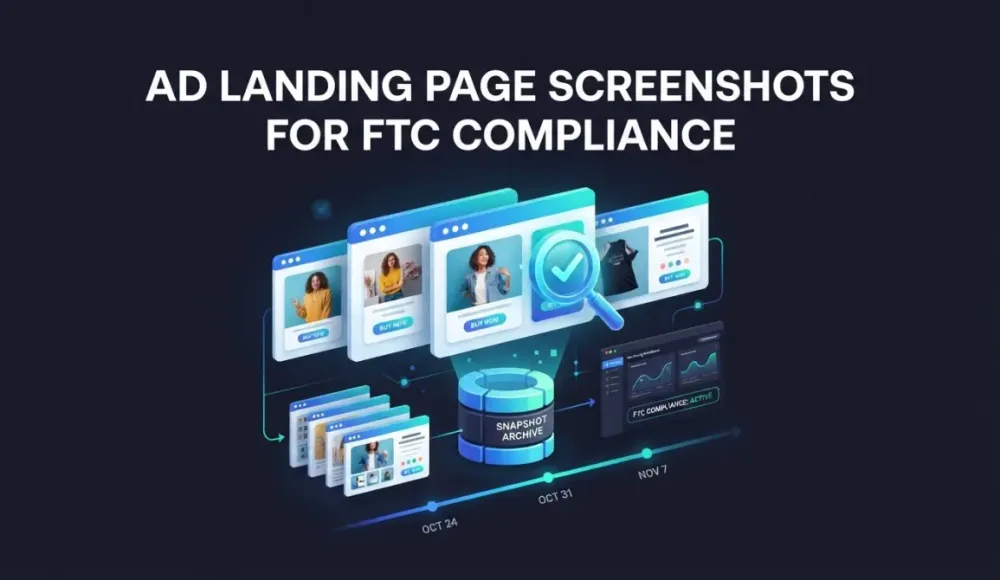
Landing pages change constantly. A/B tests, new offers, updated claims, seasonal copy swaps. If you're running paid ads on Google or Meta, the page your ad points to today probably won't look the same three months from now. And if the FTC decides to investigate your advertising claims, they're going to look at what the page said during the campaign. Not what it says now.
Here's the problem. By the time an investigation happens (months later, sometimes years), the original landing page is gone. Your CRO team ran four iterations since then. Nobody saved the old versions. You can't prove what disclosures were visible, what claims were made, or whether the ad matched the page it linked to.
An FTC ad compliance screenshot — a timestamped capture of what your landing page showed — is the simplest way to build that record. Without one, you're left arguing about a page nobody can look at anymore.
What the FTC actually looks for on landing pages
FTC enforcement around advertising isn't complicated to understand. They care about a few things. Are the claims on the page truthful? Can you back them up? Do the disclosures show up where people can see them, or are they buried in 8pt gray text below the fold?
And here's one that trips people up: ad-to-page consistency. If your Google Ad says "lose 20 pounds in 30 days" but the landing page says something softer, that mismatch is a problem. If the landing page makes a bold claim but the fine print contradicts it, also a problem. The FTC has gone after supplement companies, fake booking sites, and DTC brands for exactly this.
They investigate retroactively. Nobody from the FTC is watching your landing page in real time. They look into it after a complaint, after a competitor tips them off, after a pattern shows up across multiple advertisers. By then, the page you were running during the campaign has been swapped out three times.
Performance marketers have a records problem
Anyone running Google or Meta ads at scale deals with this. You test dozens of landing page variants. Offers rotate. CRO teams tweak headlines weekly. Affiliate marketers might not even control the landing pages they send traffic to.
Ask yourself: can you pull up exactly what your landing page showed on a Tuesday in March? Most teams can't. Browser extensions and the Wayback Machine are unreliable for this, and I say that as someone who used to rely on both. They capture sporadically, miss dynamic content, and don't give you anything with a verifiable timestamp.
If you're in health, finance, or weight loss verticals, the documentation gap matters more. Those are the industries the FTC watches closest. And agencies running campaigns for clients carry risk too. When a client's landing page gets flagged, the agency gets pulled into it.
How timestamped screenshots prove ad compliance
The fix is straightforward: take scheduled compliance screenshots of every active landing page and store them with timestamps and cryptographic proof. You get a visual archive of what the page showed on each date, including disclosures, claim language, offer details, and fine print.
We've written about why screenshots work as legal evidence before. Short version: a screenshot with a SHA-256 hash and a UTC timestamp holds up in ways that a PDF printout from your browser doesn't.
It's compliance archiving applied to ad campaigns. Same principle HR teams use for job postings, same approach legal teams use for regulatory record-keeping. The subject is different but the need is identical: prove what a page said on a specific date.
How Snapshot Archive fits here
Snapshot Archive takes scheduled screenshots of URLs you give it. Set it to daily or every few hours, and it captures full-page screenshots that include everything from the hero to the disclaimers at the bottom. Each capture gets a UTC timestamp watermark and SHA-256 hash.
For ad landing pages, the setup takes about two minutes. Add your landing page URLs, pick a capture frequency that matches how often you rotate content, and let it run. Weekly content rotation? Daily captures are probably enough. If you swap offers every day, go with every 6 hours.
You can export any capture as a PDF with a SHA-256 certificate, which is what you'd hand to a legal team or regulator.
Worth being direct about what SA doesn't do: it won't scan your copy for non-compliant claims or check whether disclosures meet FTC guidelines. There's no connection to Google Ads or Meta. It takes screenshots and stores them with proof. That's the scope. If you need automated claim verification, that's a different category of tool. SA handles the evidence layer.
Making this work on a real budget
If you run 10-15 active landing pages (which is pretty standard for a mid-size DTC brand or agency), you'd want enough URL slots to cover each page variant. Starter plan is $19 a month for 20 URLs. Free tier covers 3 URLs with daily captures and 30 days of retention, which is enough to test whether this actually solves your problem before paying for anything.
Most teams don't think about landing page evidence until they need it. Same pattern we see with job posting archiving and terms-of-service tracking. The record matters when it's already too late to create one. Setting up captures before a campaign launches costs almost nothing. Trying to reconstruct what a page showed eight months ago costs a lot more.
Start archiving websites today
Free plan includes 3 websites with daily captures. No credit card required.
Create free account
The Deploy That Broke Our Hero Section for 63 Hours
We pushed a one-line CSS fix on a Friday, closed our laptops, and didn't realize the hero section was broken until Monday. Every automated test had passed.
We Caught a 32% SaaS Price Drop Live
On April 27th, proxy-cheap dropped their Static Residential Proxy price from $3.39 to $2.29 with zero announcement. We caught it the same morning.
API Docs Update: Filtering, New Endpoints, and Code Examples in Four Languages
Filtering and sorting on all list endpoints, two new endpoints, code examples in cURL, PHP, Python, and Node.js, and a published OpenAPI spec.